

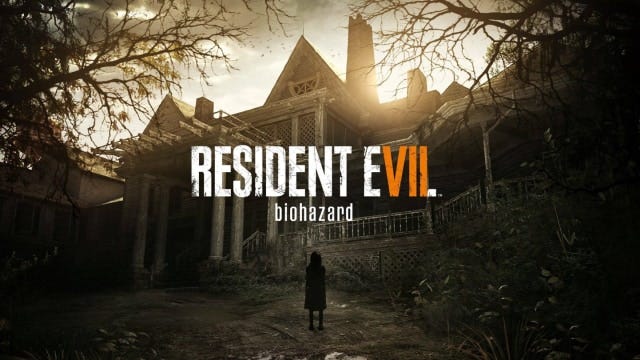
Capcom has reported its highest software unit sales for the first half of a fiscal year in its 47-year history, with 36.86 million units sold (+54.5% YoY) supported by strong catalog sales and continued demand for new releases. The milestone reflects the publisher’s ability to generate sustained revenue from established franchises while introducing new IP and reviving older series. According to Capcom’s financial report for the six months ending September 30, 2026, Onimusha: Way of the Sword surpassed 1.7 million units sold and Pragmata exceeded 2.7 million units. Catalog titles including Monster Hunter: World, Resident Evil 2 and Resident Evil 7 Biohazard also contributed to the record performance, demonstrating the long-term commercial value of Capcom’s existing portfolio.
Why this matters: Capcom continues to benefit from a strong portfolio of back catalog titles, which accounted for 87.3% of sales during the period. Resident Evil 4, which launched in 2023, sold an additional 3.5 million units in the past six months, taking total sales to 17.15 million. Digital distribution accounted for 92.4% of Capcom’s software unit sales during the period, with PC representing 57.1% and consoles accounting for 35.3%. Physical sales contributed just 7.6%, highlighting the company’s increasing reliance on digital storefronts and the growing importance of PC as a distribution platform.
Join Niko Partners and Xsolla’s panel at gamescom asia
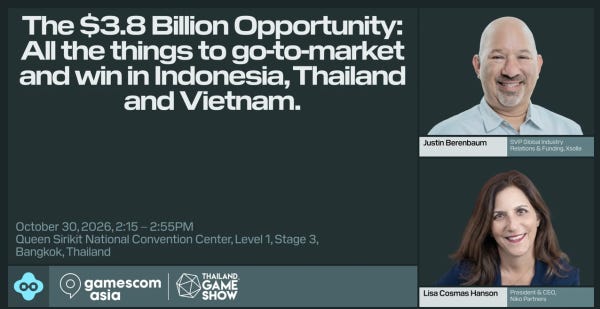
If you’re going to gamescom asia, check out our panel on how to go big in Indonesia, Thailand, Vietnam. Niko’s CEO Lisa Cosmas Hanson and Xsolla’s SVP Global Industry Relations & Funding Justin Berenbaum will share about what local payments, pricing, and go-to-market strategy that works in these three notable SEA markets.
Don’t miss this session on 30 October at 2:15 PM at the Queen Sirikit National Convention Center, Plenary Hall, Level 1, Stage 3. Mark your calendar and be part of the conversation. See you there!
AI-assisted reverse engineering leads to revival of discontinued games
AI-assisted game preservation and reverse engineering projects are gaining traction in China and globally, allowing enthusiasts to revive discontinued games, port older titles to new platforms and introduce gameplay modifications with less manual development work. The trend reflects the growing accessibility of AI coding tools and their potential to reduce technical barriers to game restoration. In China, creators on Bilibili have showcased playable revival projects for discontinued titles previously operated by major publishers such as Tencent, NetEase and Bilibili. Similar projects have emerged internationally, involving franchises such as Halo, Grand Theft Auto: Vice City, and Call of Duty: Black Ops. On October 14, Microsoft also announced a dedicated team exploring game decompilation, cross platform compatibility and player driven creation.
Why this matters: AI is accelerating reverse engineering by helping developers reconstruct readable code from existing games, reducing work that previously required extensive manual analysis. However, copyright restrictions and ongoing server maintenance costs remain major obstacles to making revived games publicly available and sustainable. Moreover, technical feasibility does not automatically grant developers permission to distribute or operate modified versions of commercial games. This poses both a challenge to game developers, as well as an emerging opportunity for new ways to enhance existing IP.
Link to original article (Chinese) →
Japanese players are big fans of single-player games
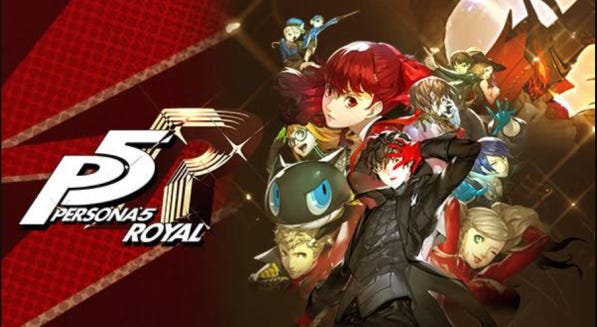
Single-player games continue to thrive in Japan, and the numbers tell a compelling story. Persona 5, one of Japan’s most beloved single-player franchises, has surpassed 13 million copies sold worldwide, highlighting the enduring appeal of narrative-driven solo experiences. According to a recent Niko Partners survey, 80.2% of Japanese gamers prefer single-player games. That’s the highest percentage among the 13 Asia and MENA markets tracked by Niko Partners.
Japan remains a market where immersive, story-rich solo gameplay continues to drive engagement and commercial success. Learn more from Niko’s East Asia Player Behavior & Market Insights Reports here.
Logitech G to establish Shanghai innovation center
Logitech G has announced plans to establish a technology research and innovation center in Shanghai in early 2027, strengthening its commitment to incorporating Chinese consumer insights into product development and global innovation. The facility will be located in Shanghai’s Jing’an district and forms part of Logitech’s long-term strategy of developing products in China for both domestic and international markets. The Logitech China Technology Research and Innovation Center will focus on emerging technologies, including cloud gaming ecosystems, edge artificial intelligence, generative AI and intelligent video collaboration.
Why this matters: The investment reflects the growing importance of China not only as a major market for gaming hardware and peripherals, but also as a source of product innovation. By establishing local research capabilities, Logitech G aims to better understand Chinese gaming preferences, emerging technologies and evolving hardware requirements while strengthening its ability to respond to market trends. According to Niko Partners 2026 Player Survey Data, approximately 20% of Chinese players have purchased additional gaming accessories for their gaming device in the past 12 months, accounting for nearly 150 million players.
Nintendo to launch eShop and Switch Online in the Philippines
Nintendo has announced that the Nintendo eShop and Nintendo Switch Online services will officially launch in the Philippines on November 10, 2026, expanding its digital distribution and subscription services in Southeast Asia. The services will be available for both Nintendo Switch and Nintendo Switch 2 users, providing direct access to digital game purchases, downloadable content and Nintendo Switch Online memberships. The announcement follows the official launch of Nintendo Switch 2 in the Philippines on June 26, 2025, priced at PHP 31,990.
Why this matters: Despite the console’s local release last year, Nintendo did not initially provide official access to its digital storefront or online subscription services. Filipino players have instead relied on changing their Nintendo Account region to another supported market to access these features. Nintendo has steadily expanded its presence in the Philippines through the launch of a localized website, official e-commerce channels and its first authorized retail store at SM Makati in May 2026. The introduction of local digital services represents another step toward establishing a more comprehensive commercial and distribution infrastructure in the country.
Job listings reveal direction of China’s games industry
A look at the hiring pages of 60 Chinese game companies showed more than 8,500 game development related job openings in October 2026, indicating sustained recruitment despite a decline in vacancies compared with spring 2026. Job descriptions reveal growing demand for Unreal Engine 5 (UE5), generative AI, technical art, global publishing and open-world game development expertise. UE5 is increasingly prominent in new projects, particularly those targeting multiple platforms and high-fidelity visuals. Shooter development is diversifying beyond battle royale into extraction, tactical, PvE and large-scale warfare formats. Life simulation and social MMO projects are also attracting investment.
Why this matters: The findings indicate that Chinese developers are continuing to invest in technically ambitious, multiplatform games while diversifying beyond traditional RPG and shooter formats. AI recruitment is becoming more specialized, with positions focused on AI agents, NPC behavior, content generation, level design and production workflows, suggesting AI is moving from experimental initiatives toward dedicated production roles. However, job listings indicate development priorities rather than confirmed project launches or future commercial success.
Link to original article (Chinese) →
VNGGames partners with Hai Phong authorities to host Games ON gaming, esports festival
Games ON: Hai Phong 2026 brought gaming and esports into a public urban setting, combining national-level competitions, gaming experiences, music, and local food businesses. Held on October 10-11 at Hai Phong City Theatre Square, the festival was organized by VNGGames in coordination with the Hai Phong People’s Committee, with esports finals supported by the city’s Department of Culture, Sports and Tourism and the Vietnam Recreational and Electronic Sports Association (VIRESA). The event featured three national-level finals across Teamfight Tactics and League of Legends, 32 competitors, and experiences featuring more than 20 VNGGames titles. Reportedly, the festival attracted nearly 50,000 visits.
Why this matters: The event demonstrates how publishers can extend gaming beyond online platforms and dedicated venues to reach broader audiences and connect esports with tourism, food, music, and local commerce. For local authorities and esports organizers, the model could diversify night-time cultural offerings while giving national competitions greater public exposure. Its longer-term significance will depend on whether future editions can sustain audience interest, support local businesses, and provide reliable measures of economic and esports-development outcomes.
Link to original article (Vietnamese) →
Niko delivers the ‘why-behind-the-what’ that AI tools cannot.
iDreamsky partners with Shenzhen government on gaming fund
Chinese game publisher iDreamSky has entered a strategic partnership with Shenzhen Nanshan Strategic Emerging Industries Investment Co., Ltd., a state-owned investment company, to establish a RMB 200 million (approximately $30 million) gaming industry investment initiative. The partnership aims to support game development, publishing and related technology businesses in Shenzhen’s Nanshan District. The investment will be channeled through Gametopia, Nanshan District’s official gaming industry incubation platform, with a focus on promising local developers and businesses operating within its ecosystem. Priority areas include game research and development, AI-assisted content production, publishing services and supporting businesses across the gaming industry value chain.
Why this matters: The partnership will also support the expansion of iDreamSky’s publishing operations, particularly its efforts to bring overseas games into the Chinese market. The company plans to leverage its existing pipeline of international titles, including Gardenscapes (WeChat Edition) and War Robots, alongside partnerships with other game publishers. The initiative aims to strengthen local publishing capabilities while creating additional opportunities for developers and service providers in Nanshan. The agreement represents a further expansion of government-backed investment in China’s gaming industry, with Nanshan District deploying state capital to support both emerging developers and established publishing businesses.
Link to original article (Chinese) →
NetEase strengthens Marvel Rivals moderation following player backlash
NetEase has announced stricter penalties for toxic behavior in Marvel Rivals following criticism from Western players and content creators over changes to the game’s reporting system. The controversy emerged after hate speech was removed as a dedicated reporting category, raising concerns about how discriminatory behavior would be reported and whether such violations would receive appropriate attention. The developer has since clarified that insults, harassment, discrimination and hate speech remain prohibited across both text and voice communication.
Why this matters: NetEase confirmed that it has escalated penalties for speech violations, with sanctions determined by the nature and severity of the offense and the player’s previous disciplinary record. Severe or repeated violations will receive significantly harsher punishments. The company also described speech moderation as an ongoing commitment, pledging to improve its systems for detecting and addressing toxic behavior. Discussions on Reddit prior indicated that some players believe toxic communication has negatively affected their experience, with some reporting that they have stopped playing.
Game services provider Side expands China operations
Global game services provider Side, formerly known as Pole to Win, has acquired Chengdu-based art outsourcing studio Roboto Entertainment, expanding its production capabilities in China and strengthening its global art services business. The acquisition will establish Side Chengdu, a new studio specializing in environment art and world-building for video games. Roboto Entertainment has experience supporting AAA and AA console and mobile games, and will collaborate with Side Shanghai and the company’s international operations across the Americas, Europe, the Middle East, Africa, and Asia.
Why this matters: Founded in 2009 with Japanese roots, Side operates more than 15 studios across over a dozen countries. Its existing services include quality assurance, localization, player support, audio production, art, co-development and data services. The move also reflects continued consolidation in the game services sector, as outsourcing providers expand their capabilities and geographic reach to compete for increasingly complex development contracts.
KRAFTON India launches BGMI Survivor League with 50 creators, $73,520 prize pool
KRAFTON India launched The Final Mahayudh: Survivor League, a 30-day Battlegrounds Mobile India creator competition running from October 18 to November 17, with 50 established and emerging creators representing a combined 69.7 million subscribers. Fans join a creator’s team, with their playtime and completed daily missions adding points to that creator’s score on a shared weekly leaderboard; the Switch phase on October 24 and 25 allows fans to change teams while retaining their accumulated points. The $73,520 (INR 7 million) prize pool is distributed among all 50 creators, with $12,600 (INR 1.2 million) for the winner.
Why this matters: Participants include notable creators such as Jonathan Gaming, Shreeman Legend, Snax Gaming, and others.The format makes fan activity a measurable part of creator competitions, giving creators an incentive to mobilize their communities and sustain engagement throughout the month. For publishers and gaming businesses, this offers a model for connecting in-game participation with creator marketing, although its commercial value will depend on actual player activity, retention, and audience response rather than subscriber reach alone.
Events

gamescom asia x Thailand Game Show
October 29 - November 1, 2026
Bangkok, Thailand
Attendees: Niko Partners Senior Leadership Team, Nina Kitkrua
GamesBeat NEXT
November 2-3, 2026
San Francisco, USA
Speaker: Lisa Hanson
Montréal International Game Summit (MIGS)
November 10-11, 2026
Montreal, Canada
Speaker: Alexander Champlin
G-Star
November 19-21, 2026
Busan, South Korea
Attendee: Shin Young Kim