

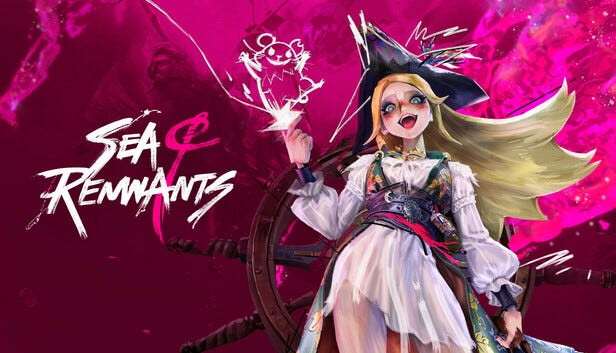
The National Press and Publication Administration (NPPA), mainland China’s regulator in charge of game approvals, issued ISBNs for 147 domestic games and 7 import games on April 29, 2026. This is the third batch of games approved in 2026 and takes total approvals to 600 domestic games and 21 import games The domestic batch included 135 mobile games, 1 PC game and 11 cross platform games, while the import games list included 3 mobile games, 2 PC games and 2 cross platform games. The most notable domestic approval was NetEase’s Sea of Remnants, its pirate adventure RPG. The most notable import game approval was Nexon’s Arc Raiders, which is set to be published by Tencent in China. A total of 13 games were included on the updated ISBN list where publishers can request a name change, publisher change, or additional platform for an existing ISBN. We expect more than 2,300 video games to be approved this year, with over 100 of them being import games.
Link to original article (Chinese) →
Livestreaming Tracker April 2026 Highlights: Tencent’s Honor of Kings: World Rises into April’s Top 10 RPG Viewership Rankings
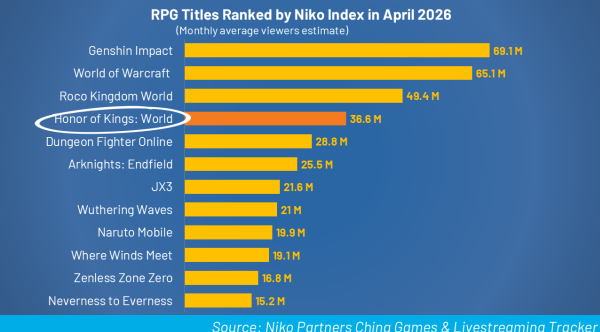
RPG titles dominated China’s livestreaming landscape in April 2026, standing out as some of the month’s most-watched content. Niko Partners’ China Games & Livestreaming Tracker reveals that RPG games remained one of the most-watched genres in China’s livestreaming market in April 2026, with newly launched title Honor of Kings: World emerging as the latest driver of the genre’s overall performance. Notably, this marks the second Tencent RPG title in two consecutive months to significantly lift RPG viewership, following the strong performance of Roco Kingdom World in March.
Read our quick take on the standout title from this month’s top 10 shooter games, based on the Niko Index, our proprietary metric for estimating total viewership across games, streamers, and categories.
Sony looks to combat piracy with one time license check
After player speculation around a new DRM policy, Sony Interactive Entertainment have confirmed that PlayStation games will have a one time online check to confirm the games license is legitimate, with no further checks required. The statement comes after players raised concerns over a 30 day timer attached to the license of newly purchased games, which many thought would indicate an ongoing license check reminiscent of the original Xbox One licensing pitch that was widely rejected by gamers and caused Microsoft to reverse course at the time.
Why this matters: While piracy on the PS5 is extremely limited and impractical for most users, an exploit did allow players to purchase a game and obtain a permanent license key without having to download the game itself. The game could then be refunded, allowing the player to use the previously obtained permanent license key to download and play the game after the refund had been processed. Older generations of consoles continue to remain the most exploitable and vulnerable to piracy, whereas modern consoles have been fairly hard to crack.
Tencent increases stake in Black Myth: Wukong developer
Tencent has increased its stake from 5% to 24% in Game Science, the developer of Black Myth: Wukong. The news was confirmed in updated financial statements that also showed that Hero Games, the original backer of the studio, had divested its 19% stake in the company, selling its share to Tencent. The company is now the sole external shareholder. Hero Games originally invested in 2017, prior to the announcement and development of Black Myth: Wukong.
Why this matters: Tencent first invested in Game Science in 2021, taking a 5% stake. The studio will continue to maintain creative and financial control, while leveraging Tencent’s support across marketing, distribution, and more. Black Myth: Wukong was released on August 20, 2024, on PC and consoles, quickly becoming a hit. The game went on to sell over 30 million copies worldwide and the studio is currently developing a follow up title called Black Myth: Zhong Kui.
NC signs marketing partnership with Roblox Korea
On April 29, NC (NCsoft) announced it signed a marketing MOU with Roblox Korea to collaborate on joint campaigns in the domestic market. The agreement covers online and offline marketing initiatives, co-produced branded content, and promotional activities across both companies’ official channels. As part of the partnership, NC began offering game benefits for three Roblox IP titles at its PC cafe network starting the same day, with plans to expand the lineup. The companies stated that the collaboration aims to broaden user engagement and enhance access to Roblox content among Korean players.
Why this matters: The agreement comes amid a rise in partnership between Western IPs and Korean video game companies to strengthen distribution in the country. Most recently, Blizzard partnered with Nexon to operate Blizzard in the country. Both partnerships also highlighted the need to reach PC café players in the country, who are a notable constituency in terms of time and spend. The initiative also reflects efforts to leverage combined platforms and intellectual property for increased market reach.
Link to original article (Korean) →
Pearl Abyss divests from CCP Games in management buyout
South Korean game company Pearl Abyss is divesting CCP Games, the studio behind EVE Online, via a management buyout led by CCP CEO Hilmar Pétursson. Korean reports indicate the transaction values CCP at approximately KRW 177 billion ($120 million), with closing expected this week. Pearl Abyss stated the divestment is intended to improve the financial structure of both companies while preserving the possibility of future collaboration. The divestment also comes as Pearl Abyss shifts strategic focus toward its internally developed premium portfolio, including the successful launch of Crimson Desert.
Why this matters: The sale represents a substantial markdown from Pearl Abyss’s 2018 acquisition price of $425 million, implying a roughly 72% reduction in enterprise value over eight years. While unconfirmed, the move reportedly follows years of operating losses at CCP despite the continued resilience of EVE Online, suggesting the studio has struggled to deliver sufficient profitability or pipeline expansion under Pearl Abyss ownership.
Zenless Zone Zero to release on Steam
MiHoYo has launched a Steam store page for Zenless Zone Zero, confirming a Q2 2026 release on the platform and opening recruitment for an advance test. The title’s Steam listing is currently unavailable in mainland China, consistent with prior regional distribution practices. The move is strategically notable as it marks HoYoverse’s first deployment of an active flagship live service title on Steam in several years. Since Honkai Impact 3rd launched on Steam in 2021, the company has kept larger titles such as Genshin Impact and Honkai: Star Rail off the platform, favoring direct distribution and deals with the Epic Games Store.
Why this matters: Performance of Zenless Zone Zero on the platform is likely to inform whether HoYoverse expands Steam support to broader flagship titles over time. While bypassing Steam historically allowed the company to avoid platform fees and retain direct user relationships, the addition of Steam implies growing prioritization of reach and discoverability over pure margin optimization. Launching on Steam is an accepted practice among Chinese premium game developers, but is still debated among some F2P developers, who prefer to launch their own client.
Link to original article (Chinese) →
Chinese court rules on account reselling
A court in Ningbo has ruled in favor of Bilibili in an unfair competition case involving the sale of game accounts used to bypass real name verification requirements. The defendant, a game related company operating storefronts on an ecommerce platform, was ordered to pay RMB 800,000 ($110,000) in damages and legal costs. According to the court, the defendant sold accounts for more than 20 popular Bilibili server games, with some listings reportedly exceeding 500,000 group purchase orders. These accounts had already been bound to verified adult identities, allowing buyers to log in without undergoing additional real name authentication and thereby circumventing China’s minor protection and anti-addiction systems.
Why this matters: The ruling strengthens legal precedent in China supporting platform enforcement against gray market account trading, particularly where such activity undermines youth regulation compliance. For publishers and platforms, this provides stronger legal backing to pursue third parties facilitating circumvention of regulatory safeguards.
Link to original article (Chinese) →
Wemade settles royalty dispute over MIR IP
On April 29, Wemade announced it had reached a settlement with Chinese game company Kingnet, concluding a long running dispute over unpaid royalties related to The Legend of Mir 2. Under the agreement, Wemade will receive approximately KRW 43 billion ($30.7 million), marking a rare case of meaningful settlement for a Korean game company in a China related IP dispute. The conflict stemmed from nonpayment of royalties tied to a game operated by a Kingnet subsidiary since 2016, amid broader issues of unauthorized sublicensing and missed payments in the Chinese market.
Why this matters: Wemade had pursued both ICC arbitration and litigation in Chinese courts, securing recognition of contract validity and its status as the copyright holder, with a March ruling this year rejecting claims against its licensing rights. The company stated it opted for settlement after considering prolonged legal uncertainty and challenges in enforcing judgments in China.
Link to original article (Korean) →
No AI tool can deliver the deeper insights you can only get with Niko Partners.
ChinaJoy sees strong profit growth ahead of 2026 event
ChinaJoy generated RMB 126 million ($17.4 million) in operating revenue and RMB 55.53 million ($7.7 million) in net profit in 2025, representing YoY growth of 7.92% and 14.7%, respectively. Profit growth was driven by higher visitor traffic and expanded corporate booth sales. The 22nd ChinaJoy, held in August 2025 attracted 410,300 cumulative visitors, up 11.8% YoY. Out of region and overseas attendees accounted for 61% of total traffic, with international visitors reaching 14,700, highlighting growing geographic diversity and international relevance. ChinaJoy 2026 will be held at the Shanghai New International Expo Centre from July 31 to August 3.
Why this matters: Organizers are expanding the event’s strategic focus beyond traditional gaming to drive growth in 2026. Under the “Level Up With AI” theme, ChinaJoy is increasing investment in AI related conference programming and exhibitor recruitment, reflecting rising overlap between gaming and AI ecosystems. The event is also significantly expanding toy, figure, and brand exhibition areas to capitalize on growing demand for gaming adjacent merchandise and IP monetization. Support for indie developers is likewise being increased.
Vietnam’s mobile game sector reportedly ranks second globally in downloads while shifting toward sustainable monetization
Vietnamese mobile games reached 4.9 billion downloads globally in 2025, ranking second only to China, according to GameGeek’s report backed by Sensor Tower and AppsFlyer. Nearly 95% of those downloads came from overseas markets, with India, Brazil, and Indonesia leading, while IAP revenue grew 83% year over year. What matters most to Niko Partners’ readers is not the download volume itself, but the underlying shift — Vietnam is moving toward exportable, longer-life mobile games and 73% of studios have reportedly moved away from ad-only revenue toward in-app purchases or hybrid models.
Why this matters: The pivot, combined with studios concentrating resources on one to three long-running titles, signals a genuine maturation in how Vietnamese developers build and sustain products. For investors and publishers, the opportunity is in studios that have already made this transition, since lifecycle management and Android-first distribution design will define which ones scale internationally.
HarmonyOS reaches 55 million users in China
HarmonyOS was running on more than 55 million smartphones as of the end of March, underscoring the continued expansion of Huawei’s proprietary operating system ecosystem. Growth has accelerated alongside Huawei’s smartphone market recovery, with Huawei becoming the #1 smartphone manufacturer by annual shipments, ahead of Apple. Huawei is actively building out platform support through Huawei Game Center, which is positioning itself as a dedicated distribution and community hub for games on HarmonyOS. The company is also emphasizing mini games and lightweight experiences optimized for HarmonyOS.
Why this matters: HarmonyOS requires native application and game development, creating a distinct platform ecosystem rather than relying on Android compatibility. While still substantially smaller than Apple’s installed base of approximately 250 million iPhone users in China, HarmonyOS’ scale is increasingly material for developers, particularly as it continues to grow within Huawei’s own domestic hardware ecosystem.
Events
Vietnam GameVerse 2026
May 8-9, 2026
Ho Chi Minh City, Vietnam
Attendees: Linh Diep, Hung Tang
GamesBeat Summit
May 18-19, 2026
Los Angeles, USA
Speaker: Lisa Hanson
Attendee: Alexander Champlin