

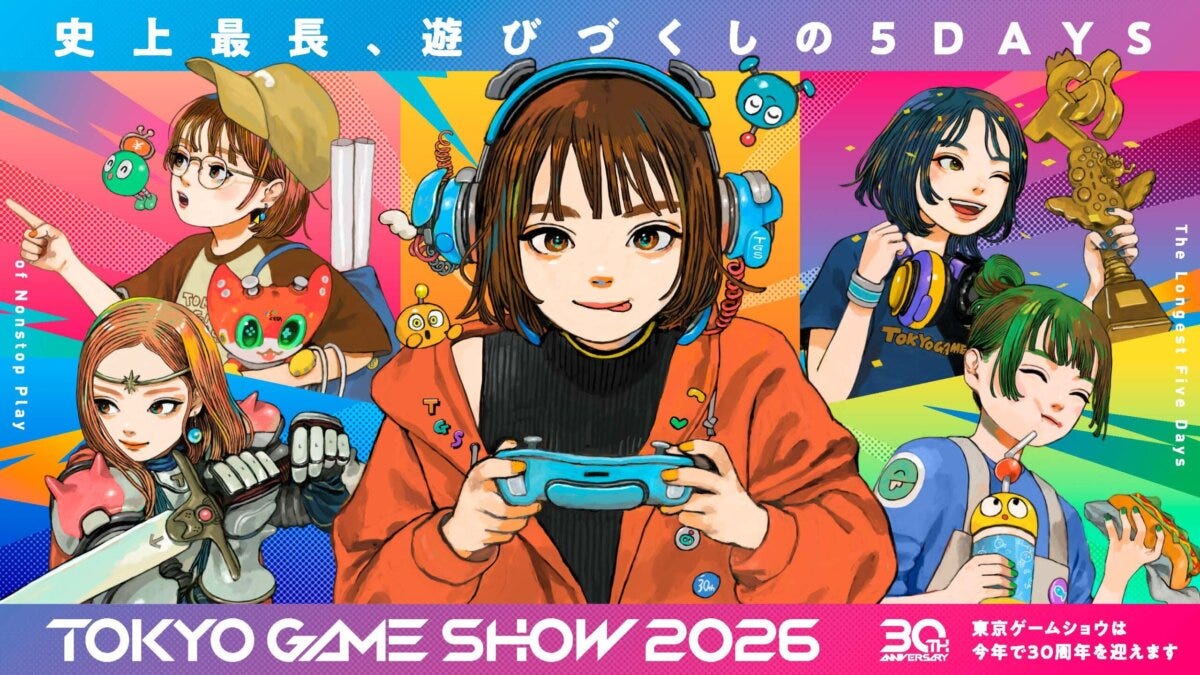
The Computer Entertainment Supplier’s Association (CESA) has announced a record breaking Tokyo Game Show (TGS) 2026, with 759 exhibitors, 3,946 booths, and participation from 51 countries and regions. To mark the event’s 30th anniversary, TGS has expanded from four to five days, including three public days, with attendance expected to exceed 300,000 visitors. Despite the event’s overall growth, participation from Chinese game companies has fallen sharply. The number of exhibitors from mainland China declined from 112 in 2025 to 72 this year, while exhibitors from Hong Kong fell from 18 to just two.
Why this matters: Several major Chinese publishers that maintained a strong presence in recent years, including Tencent’s Level Infinite, NetEase, Perfect World, Seasun, Papergames, Hypergryph, Bilibili, Manjuu, Century Huatong, and Hero Games, are absent from the consumer exhibition area. miHoYo will also miss the event for a second consecutive year. While there is no official explanation, broader geopolitical tensions and reduced China-Japan exchanges may have made high profile participation less attractive for some large publishers.
Link to original article (Chinese) →
Roblox expands Hindi language support across platform and creator tools in India
Roblox introduced Hindi language support across its platform, Creator Hub, and Roblox Studio in July, allowing users to switch the interface to Hindi and enabling creators to use automatic translation for supported content, including in-game strings, game names, products, and descriptions. The update also includes Hindi SEO support to improve search discoverability and plans to add Hindi chat translation in the future as part of its localization efforts. With this rollout, Roblox now supports 17 languages and aims to expand access for Hindi-speaking players and creators in India.
Why this matters: Local language support is becoming an important competitive advantage as gaming platforms seek deeper engagement beyond English-speaking users. Improved accessibility and content discovery can help creators reach larger domestic audiences while encouraging more user-generated content. The rollout also signals that India’s linguistic diversity is increasingly shaping product strategy, making localization a practical investment for platforms seeking long-term user growth and creator retention.
China recorded 50 games-industry related M&A deals in H1 2026
Approximately 50 video game related mergers, acquisitions, and investment transactions were recorded in mainland China during the first half of 2026, highlighting continued capital activity despite a more selective funding environment. Around half of the companies involved in transactions were founded within the past two years, including several independent game studios. However, investment activity has become increasingly concentrated around familiar founders and established development trends rather than new entrants.
Why this matters: More than half of the projects founded by high profile industry veterans are focused on strategy games, ACGN titles, or casual party games, suggesting investors continue to favor commercially proven categories over more experimental concepts. At the same time, nearly all angel investments during the period went to teams with backgrounds at major game companies, while first time founders and independent developers with no established industry track record attracted comparatively little capital.
Link to original article (Chinese) →
Indonesia seeks deeper collaboration with the United States to support video games and esports talent development
Indonesia’s Creative Economy Minister Teuku Riefky Harsya invited the U.S. Embassy in Jakarta to expand collaboration between Indonesian and American creative economy stakeholders, particularly in the video games industry, and proposed establishing American Corners within creative hubs across Indonesia. The minister stated that esports has become an important part of Indonesia’s creative economy, creating opportunities for athletes, casters, content creators, coaches, event organizers, and other professions within the video games and esports ecosystem. This is in line with the American Spaces Indonesia Esports Development (ASIED) program which trained young digital talent through workshops covering competition management, broadcasting, league operations, graphic design, content creation, and match commentary, reaching more than 1,750 participants and 50 esports communities across seven Indonesian cities over seven months.
Why this matters: Indonesia’s government is increasingly recognizing esports and gaming as drivers of creative economy growth and employment. Expanded collaboration between international institutions and local stakeholders could accelerate talent development and strengthen Indonesia’s position as one of Southeast Asia’s largest gaming and esports markets.
Gameloft and Tencent soft launch mobile GTA-like game
Gangstar Mirage City has opened pre-registration. Developed by Gameloft and published globally by Tencent subsidiary Level Infinite, the title brings an open world urban action experience to iOS and Android, positioning itself as one of the few mobile games targeting the same sandbox gameplay audience as Grand Theft Auto. The game has been designed with emerging markets in mind with a soft launch planned across South Asia, Southeast Asia, Eastern Europe, MENA, and Latin America on August 20, 2026, and a current soft launch underway in the Philippines.
Why this matters: Accessibility has been a key design priority. At launch, the game will support nine languages, including English, Arabic, Indonesian, Thai, Russian, Tagalog, Turkish, Latin American Spanish, and Brazilian Portuguese. It also features low minimum hardware requirements and a lightweight initial download, allowing it to run across a broad range of smartphones without requiring flagship devices. The emphasis on localization, low hardware requirements, and broad regional rollout comes just ahead of Grand Theft Auto VI’s release on PS5 and Xbox Series X|S, positioning Gangstar Mirage City as a more accessible and affordable alternative for those in emerging markets who have been caught up in the GTA VI hype but don’t own a current gen console.
China approves launch of Apple Intelligence
China’s Cyberspace Administration of China (CAC) has officially approved Apple Intelligence for deployment in the country, clearing the way for Apple to introduce its AI features on iPhones. To comply with local regulations, Apple Intelligence will leverage AI capabilities provided by Alibaba and Baidu, reflecting China’s requirement that foreign AI services partner with approved domestic providers.
Why this matters: Apple Intelligence and Samsung’s Galaxy AI were the only foreign AI platforms approved in the latest licensing round. The approval removes a competitive disadvantage Apple has faced in China, where domestic smartphone manufacturers have already been offering locally approved AI features. Notably, though, the lack of AI features on iPhones did not have a material impact on sales of the device, given most AI tools in China are used within super apps like WeChat, rather than at the OS level.
Bilibili World 2026 attracts 400,000 attendees over 3 days
Bilibili World (BW) 2026 was held in Shanghai from July 10 to July 12, attracting more than 400,000 visitors, broadly in line with last year’s record attendance. The event featured 170 exhibitors from China and overseas, more than 60,000 cosplayers, and, for the first time, ticket sales outside mainland China. Visitors from more than 30 countries attended, with international attendees accounting for approximately 18% of total visitors. Since launching in 2017, BW has evolved from a niche fan gathering into one of the world’s largest ACGN conventions and an increasingly important platform for game announcements, marketing, and consumer engagement.
Why this matters: While games and anime made up some of the largest attractions and booths, BW is increasingly functioning as a platform for global entertainment. For example, Marvel Studios built a dedicated Avengers: Doomsday exhibition, and the general exhibition floor also included consumer electronics, automotive brands, collectibles, tabletop games, creator spaces, virtual entertainment, and cosplay photography, reflecting the commercialization and diversification of the broader ACGN ecosystem. The event is now just as large as ChinaJoy, if not larger. We even heard of games industry companies opting for BW over ChinaJoy 2026.
Link to original article (Chinese) →
Niko consumer insights and business intelligence dives deeper than AI.
Samsung highlights Gaming Hub user growth amid rising gaming hardware prices
Samsung revealed that its Gaming Hub available on Samsung smart TVs has continued to expand since launching in June 2022. The service now provides access to more than 4,000 games via partners, with its global monthly active and unique user base nearly doubling over the past two years. The company’s strongest growth has come from casual and party games. Between June 2025 and June 2026, the number of unique users playing these genres on Samsung smart TVs increased by more than 90% year over year in North America and by over 200% globally.
Why this matters: Samsung’s latest figures highlight the growing potential of cloud gaming on connected TVs as an alternative entry point into gaming. Rising prices for gaming PCs and consoles could encourage more consumers to access games through existing smart TVs, particularly in price sensitive markets. Right now, the majority of users are casual players who use smartphones as an input device, rather than a Bluetooth controller. This could be an opportunity for traditional gaming companies who can target new non-traditional players in addition to the rising casual segment on smart TVs.
China’s games industry employment remained stable in 2025
New employment data compiled by Chinese industry tracker GameShark indicates that mainland China’s game industry has largely stabilized after two years of workforce reductions. Based on social security records collected from 9,020 game related entities, the industry employed approximately 233,000 people across 8,381 comparable companies in 2025, a net decline of just 229 employees compared with 2024. Comparable companies reduced headcount by approximately 4,000 employees in 2024 and around 11,000 in 2023, reflecting the industry’s post pandemic correction and broader slowdown in investment.
Why this matters: When art outsourcing and support studios are included, total industry employment actually increased by 266 employees year over year, indicating that demand for external development services remained resilient despite broader restructuring. The findings contrast with continued layoffs across many Western game companies, where publishers and developers have continued to reduce headcount through 2025 and 2026. In China, the pace of downsizing appears to have slowed considerably as investment activity gradually recovered and development pipelines normalized.
Link to original article (Chinese) →
Lenovo to release cloud gaming handheld
Lenovo has announced that its Legion C700 cloud gaming handheld will launch in August, expanding its gaming hardware portfolio with a device built around Tencent’s START cloud gaming platform. Promotional images show an Xbox style asymmetric controller layout, rear programmable buttons, and active cooling vents, indicating a dedicated gaming form factor despite relying primarily on cloud streaming rather than local processing.
Why this matters: With a cloud first approach Lenovo can offer the device at a lower price point, an important consideration as rising memory and component costs have pushed up prices across gaming handhelds. While cloud gaming is fairly mature in China, and Tencent has built up a library of AAA games via its SMART platform, it’s unclear whether a dedicated cloud gaming handheld is the right fit for the market. Most cloud gaming already takes place on mobile and PC, and a dedicated device has yet to be verified in the market.
Link to original article (Chinese) →
Events
Philippine Game Dev Expo (PGDX)
July 24-26, 2026
Manila, The Philippines
Speaker: Darang Candra
ChinaJoy
July 31-August 3, 2026
Shanghai, China
Attendee: Xiaofeng Zeng