


Escape from Tarkov, developed by Battlestate Games, has announced a crossover collaboration with Escape from Duckov, marking a rare and notable partnership for the hardcore extraction shooter title. The collaboration, launched to coincide with Chinese New Year, introduces new crossover-themed content in both titles and reflects Battlestate’s willingness to engage with a game that openly parodies its own design foundations. Alongside the collaboration, Battlestate implemented a China-specific pricing adjustment for Escape from Tarkov, reducing the standard edition price from RMB 285 to RMB 199, a roughly 30% cut.
Why this matters: Escape from Duckov was one of the most successful PC game launches by a Chinese studio in 2025, surpassing 4 million copies sold to date. More than 70% of its sales came from China, where its humor-driven take on a traditionally punishing genre helped it go viral within the PC gaming community. Despite operating as an unlicensed title in China, Tarkov has built a sizable audience in the market, with an estimated 15% of total sales coming from Chinese players.
Livestreaming Tracker January 2026 Highlights: Tencent’s New Nizhan: Future Breaks into January’s Top 10 Shooter Viewership Rankings
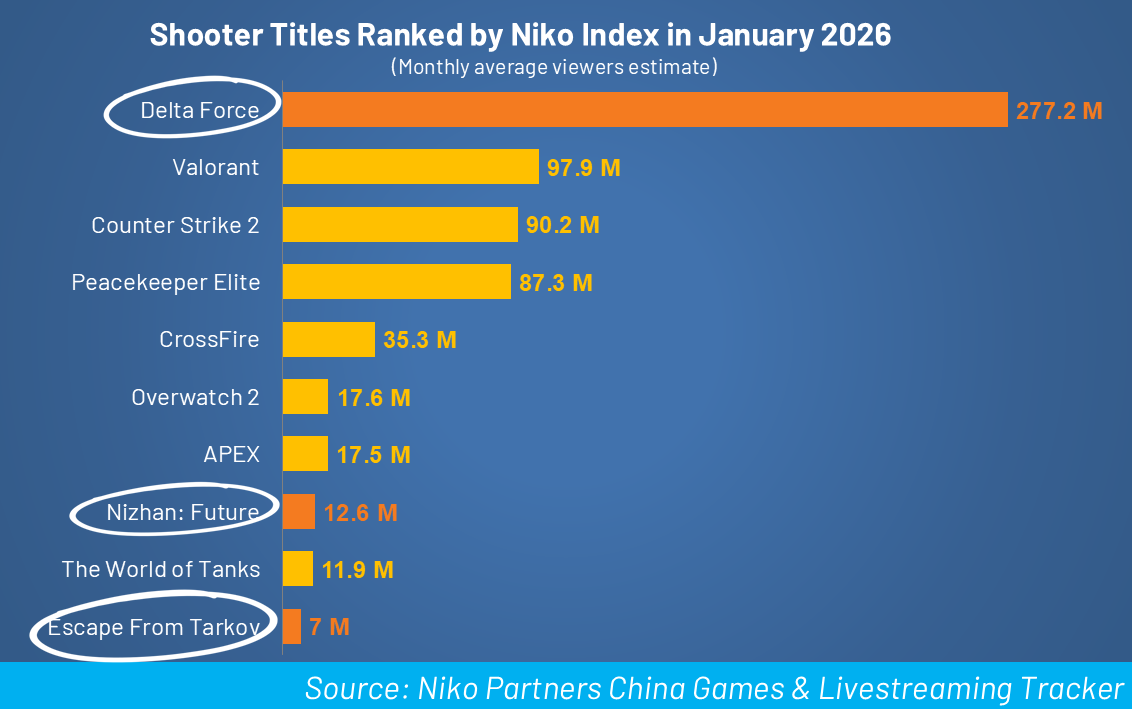
Shooter titles dominated China’s livestreaming landscape in January 2026, ranking among the month’s most-watched content, according to the Niko Partners China Games & Livestreaming Tracker. While Nizhan: Future was not the primary driver of the genre’s overall performance, its strong debut highlights how large pre-registration bases and familiarity with the Nizhan IP can accelerate first-month livestreaming traction. Read our quick take on this standout title from January’s top 10 shooter games, based on the Niko Index, our proprietary metric for estimating total viewership across games, livestreamers, and categories.
The International 2026 will be hosted in Shanghai
Valve has confirmed that The International will be hosted in China in summer 2026, signaling a major return of Dota 2’s flagship esports event to the market. TI will take place from August 20-23 at the Oriental Sports Center in Shanghai, a venue with an indoor capacity of up to 18,000 seats. The tournament will feature 16 teams, composed of direct invites alongside squads advancing through Open Qualifiers (June 9-12) and Regional Qualifiers (June 15-28).
Why this matters: Recent editions of TI have rotated through Europe, with TI14 hosted in Hamburg in 2025 and won by Team Falcons, and TI 2024 held in Copenhagen with Team Liquid claiming the title. China’s competitive narrative adds historical context to the Shanghai announcement. Chinese teams have not won TI since 2016, when Wings Gaming took the championship, and the region’s results have been mixed in subsequent years despite a large domestic player base and long-standing Dota 2 presence.
Honor of Kings to introduce $5.9 million creator program in Indonesia
Tencent’s Honor of Kings has announced the HOK Indonesia Creator Program 2026, committing IDR 100 billion ($5.9 million) in cash grants and an equivalent amount in in-game items and coupons to support creator participation and ecosystem growth. Creators participating in the program will receive benefits including early access to game content, direct communication channels with developers for feedback, and official verification. Similar strategies were launched in Malaysia and the Philippines last year with smaller investment amount.
Why this matters: The program aims to strengthen the Indonesian community ecosystem through support for community activations, content creation, events, and in-game resources. Honor of Kings‘ sizable investment signals intensified competition for creator mindshare and community building in Indonesia. The scale of commitment suggests Tencent is preparing to strengthen HOK‘s regional presence, challenging existing MOBA ecosystem leaders.
Link to original article (Indonesian) →
Mattel to fully acquire Mattel163 from NetEase
Mattel has agreed to fully acquire mobile game studio Mattel163 from NetEase, valuing the business at $318 million. The transaction will see Mattel purchase NetEase’s 50% stake in the joint venture for $159 million with the company expecting the deal to close by the end of Q1. Mattel163 was established in 2018 as a joint venture between Mattel and NetEase to develop and operate mobile games based on Mattel’s portfolio of IP. The studio’s titles include UNO, UNO Wonder, Phase 10, and Skip-Bo. Collectively, the portfolio has generated approximately 20 million MAU and surpassed 550 million global downloads.
Why this matters: Mattel stated that the acquisition will materially strengthen its digital games business by bringing core capabilities in R&D, publishing, and user acquisition fully in-house. Following the transaction, the company plans to increase mobile game output, with two new titles already planned for 2026. The deal also comes amid heightened competition in branded mobile games. Rival Hasbro has seen outsized success with Monopoly GO!, developed by Scopely, which surpassed $6 billion in lifetime in-app purchase revenue in 2025. Fully absorbing Mattel163 gives Mattel tighter control over monetization, data, and live operations, while also allowing it to benefit from licensing deals that do not involve NetEase as the developer.
AI only delivers the tip of the iceberg. Niko delivers the depth and context you need with local expertise, global perspective.
Esports centers to become skill development hubs under the 2026-2030 esports strategic plan
The Malaysian government plans to reclassify esports centers from public entertainment venues to facilities focused on training, education, and digital skills development under the 2026-2030 Electronic Sports Development Strategic Plan. Youth and Sports. Although some have proposed a dedicated esports act, the ministry does not intend to introduce new legislation; instead, it aims to table amendments to the Sports Development Act 1997 by mid-year to improve sports governance.
Why this matters: Malaysia’s plan to reclassify esports centers and consolidate governance under national standards signals a shift toward more formalized esports infrastructure. Clearer licensing and regulatory alignment could impact venue operators, teams, and developers by shaping investment, compliance expectations, and long-term ecosystem stability.
ByteDance looking to sell Moonton to Savvy according to report
ByteDance is reportedly in advanced negotiations to sell Moonton, the studio behind Mobile Legends: Bang Bang, to Savvy Games Group for an estimated $6 billion to $7 billion. According to Reuters, sources indicate the parties have reached an initial agreement on broad terms, with a transaction potentially closing by the end of the current quarter. Savvy Games declined to comment, while ByteDance and Moonton did not respond to press inquiries. The talks follow earlier reports from November that ByteDance was exploring a sale of the Shanghai-based developer.
Why this matters: Savvy Games Group has emerged as a key player in video games, acquiring Scopely in 2023. The company is also backed by Saudi Arabia’s Public Investment Fund, who recently announced they would acquire Electronic Arts. ByteDance acquired Moonton in 2021 for $4 billion but started downsizing its gaming division in 2023 after its studios were unable to deliver new hits. Mobile Legends is a key esports title globally, which fits alongside Savvy and Saudi Arabia’s push into esports with the Esports World Cup, making the potential acquisition a fit.
Sony and Nintendo expected to see impact from memory price surge
Sony may delay the launch of its next-generation PlayStation console as global RAM shortages intensify, according to a new report from Bloomberg. The report suggests Sony is considering pushing the console’s release window back to 2028 or 2029, citing sustained supply constraints and rising component costs driven largely by increased investment in AI. Likewise, Nintendo could also be forced to raise the price of the Switch 2 in 2026 if cost pressures persist. Nintendo president Shuntaro Furukawa acknowledged the risk during a recent earnings Q&A.
Why this matters: The surge in memory prices and restricted supply has been plaguing hardware manufacturers over the past few months and is expected to continue having an impact over the next year at a minimum. Valve, who do not have the same negotiating power as Sony and Nintendo, have already stated that its current Steam Deck is seeing supply issues, and that it has been unable to decide pricing for its upcoming Steam Machine. Niko Partners previously predicted that the Nintendo Switch 2 would see a price increase in 2026, which would impact adoption of dedicated gaming hardware.
NetEase reports CY2025 earnings
NetEase reported CY2025 revenue of RMB 112.6 billion ($16.1 billion), up 7.0% YoY. Its operating profit was RMB 35.9 billion ($5.1 billion), up 21.1% YoY with an operating margin of 32%, up 4 percentage points from the prior year. Growth was primarily driven by NetEase’s Games and related value-added services segment, which reached RMB 92.1 billion ($13.18 billion), up 10.2%. Revenue from online games was RMB 89.7 billion ($12.83 billion), up 11.6% YoY, while revenue from value-added services such as livestreaming was RMB 2.42 billion ($345 million), down 24.1% YoY. Gross profit for the games segment was RMB 64.2 billion ($9.19 billion), up 11.8% YoY and putting margin at 69.7% compared to 68.7% in the prior year. The increase in online games revenue was primarily due to higher net revenues from Fantasy Westward Journey Online, Identity V and newly launched games Where Winds Meet and Marvel Rivals.
NetEase highlighted that it has achieved comprehensive integration of AI across the full game development cycle, from art and design to programming, animation and quality assurance which also enables the smooth rollout of dynamic, AI-native gameplay features in multiple flagship titles. NetEase also pointed to sustainable growth of its franchises, pointing to strong performance across Fantasy Westward Journey franchise, Identity V, Eggy Party, Justice Online and Where Winds Meet, which continued to introduce high-quality content and maintain healthy player communities.
Arknights: Endfield generates $173 million in just two weeks
Arknights: Endfield, developed by Chinese studio Hypergryph, has generated more than RMB 1.2 billion ($173 million) across all platforms within two weeks of its global launch. In China, PC accounted for nearly 60% of total revenue, while in overseas markets, combined PC and PS5 revenue contributed as much as 70%. These figures reflect the platform where transactions occurred rather than exclusive playtime, as the game supports full cross-play and cross-progression across devices.
Why this matters: The platform mix is particularly notable in the context of Chinese-developed games, which have historically been dominated by mobile-first monetization. Endfield‘s performance suggests that a growing share of global players, including in China, are willing to spend on PC and console when production values, gameplay depth, and IP strength justify the experience. According to our China Games & Livestreaming Tracker, Arknights: Endfield has been the #6 most viewed title across Douyu, Huya and Bilibili during its first three weeks on the market, making it the #1 RPG game on the tracker.
Link to original article (Chinese) →
Tencent relaunches QQ Farm as a mini game
QQ Farm Classic officially returned to China on February 6, relaunching across QQ and WeChat Mini Game channels, and quickly emerged as an early 2026 breakout. By February 10, the title reached number five on the WeChat Mini Game grossing chart, signaling strong monetization momentum just days after launch with over 35 million users accessing the game. The revival is developed by Tencent’s Morefun Studio, the original team behind QQ Farm, bringing both nostalgic elements and design continuity to the project.
Why this matters: Originally launched in May 2009, QQ Farm was one of China’s most influential early social games, often compared to FarmVille, and peaked at roughly 23 million DAU during the height of China’s social gaming boom. Built directly into QQ and WeChat, friend-based interactions such as visiting farms, helping with tasks, or “stealing” crops are frictionless. Stealing your friends crops was a major feature of the original game. QQ Farm Classic demonstrates the continued power of legacy IP, nostalgia, and mini game distribution in China.
Link to original article (Chinese) →
Events
GDC Festival of Gaming
March 9-13, 2026
San Francisco, USA
Attendees: Lisa Hanson, Alexander Champlin
GamesBeat Summit
May 18-19, 2026
Los Angeles, USA
Speaker: Lisa Hanson