

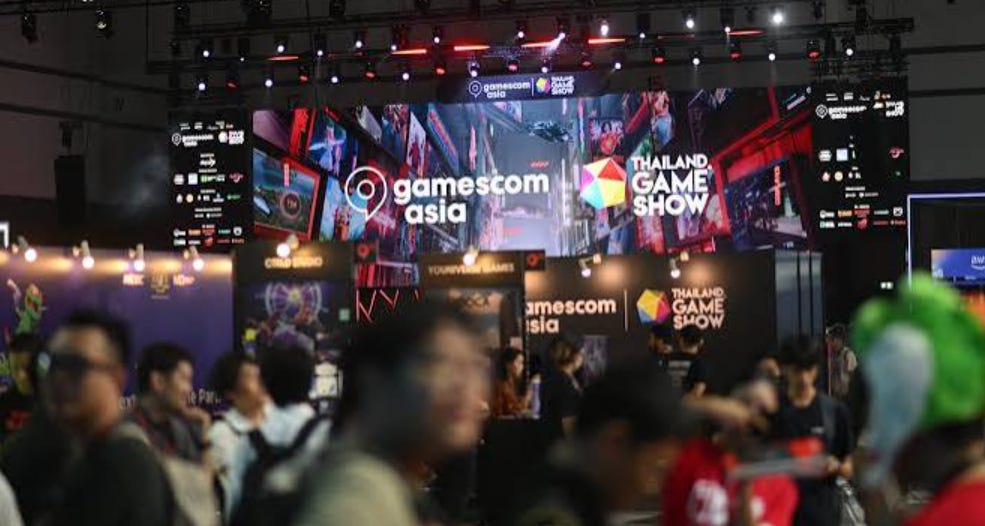
Gamescom Asia x Thailand Game Show 2026 has expanded its international participation to 20 pavilions representing 12 markets across Asia, Europe and North America, following the addition of Indonesia, Japan, Malaysia and the US. The event will feature exhibitors from 29 countries and regions, marking its most internationally diverse lineup to date. The newly announced pavilions are supported by government and trade organizations, including Indonesia’s Ministry of Creative Economy, Japan’s JETRO, Malaysia Digital Economy Corporation and the US Embassy in Bangkok. MEET US THERE! Niko Partners will have 5 senior team members in attendance: Lisa, Xiaofeng, Alexander, Darang, and Narinder, plus our Thai analyst Nina! Contact us to set a meeting.
Why this matters: The event’s expansion highlights Southeast Asia’s growing importance as a regional hub for international game publishing, investment and business development. Thailand’s role as host also reinforces its position as a meeting point between established gaming markets such as Japan, China and South Korea and emerging development ecosystems across Southeast Asia. The business area will operate from October 29 to October 30, featuring a conference with more than 80 speakers from 27 countries.
LEVEL UP KL 2026 highlights Malaysia’s ambitions for higher-value games industry growth
LEVEL UP KL 2026 brought together game developers, publishers, investors, and technology leaders in Kuala Lumpur on October 15-16, 2026, highlighting Malaysia’s efforts to accelerate games industry growth through investment, talent development, and original intellectual property creation. Organized by Malaysia Digital Economy Corporation (MDEC), the event supports the Digital Creative Ecosystem Roadmap, which targets MYR9 billion ($2.2 billion) in industry revenue, MYR6 billion ($1.5 billion) in exports, MYR 6 billion ($1.5 billion) in strategic investments, and 10,000 high-value jobs by 2030.
Why this matters: The conference featured more than 50 speakers, 25 discussion topics, five partner events, Nintendo and PlayStation industry sessions, the Asian debut of Game UX Summit, Games for Change, Xsolla Connect KL, Unreal Engine training, networking initiatives, and the SEA Game Awards, while targeting 400 business meetings, MYR120 million ($29.3 million) in export opportunities, and MYR100 million ($24.5 million) in investment opportunities. Malaysia is increasingly positioning itself as a regional game development hub by pairing investment incentives and talent programs with a stronger focus on original intellectual property creation and AI adoption.
Related: Niko Partners at LEVEL UP KL - New Blog Post
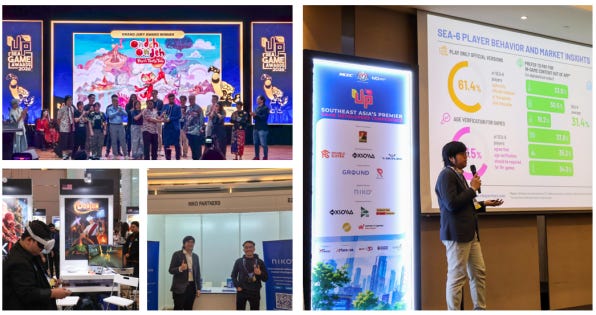
Niko Partners was proud to take part as LEVEL UP KL’ss Knowledge Partner this year. The event was a great opportunity for sharing our market insights and engaging with professional from Southeast Asia video game industry. Read what we observed from the event in this new blog post.
Tencent’s Delta Force surpasses 58 million DAUs in China
Tencent announced on October 8, 2026, that Delta Force surpassed 58 million daily active users (DAUs) in China, up from the 50 million reported in March. The milestone reinforces the game’s position as one of China’s largest multiplayer shooters, with engagement continuing to expand more than two years after its September 2024 launch. Delta Force has experienced sustained growth since 2025, when DAUs increased from 12 million in April to 20 million in July and 30 million by September. Momentum continued into 2026, reaching 41 million in January and 50 million in March.
Why this matters: A key driver has been the frequency and diversity of content updates, with 11 seasons released over two years. While extraction shooter gameplay remains central, Delta Force has expanded its appeal through large scale warfare, cooperative missions, fishing, 1v1 combat and a new 5v5 round based bomb defusal mode. This approach allows Tencent to serve different player preferences and skill levels within a single live service ecosystem. The game has also benefited from a professional esports scene, livestreaming, creator generated content, community tournaments and cross platform support between PC and mobile.
Link to original article (Chinese) →
Join us at GamesBeat NEXT

Niko’s CEO and President Lisa Cosmas Hanson will be joining as a speaker for GamesBeat NEXT 2026 on November 2-3, 2026 in San Francisco. She will be a speaker on the African Games Market Roundtable. We’re excited to meet CEOs, founders, investors, CMOs, and technology leaders shaping the future of gaming, AI, mobile, entertainment, and global consumer platforms.
Last year sold out. Niko’s network can save 25% on registration with code GBNEXT26_SPEAKER_25.
Resident Evil Reboot tops China box office
The 2026 Resident Evil reboot topped China’s box office during the October 9-11 weekend, generating RMB 81.2 million ($12.1 million) over three days. The film based on the Capcom video game franchise opened in China on October 5, during the latter part of the National Day Golden Week holiday, and has since accumulated approximately RMB 312 million ($45 million) in local box office revenue. Its worldwide gross has exceeded $325 million. The performance reinforces Resident Evil’s position as one of the more commercially successful video game film franchises in China.
Why this matters: The 2026 reboot has already surpassed the combined Chinese box office earnings of Resident Evil: Afterlife and Resident Evil: Retribution, although it remains significantly below the franchise’s highest grossing installment in the market, Resident Evil: The Final Chapter. Released in 2017, The Final Chapter generated approximately $159.5 million in China, nearly six times its $26.8 million North American box office revenue. China’s contribution demonstrated the franchise’s unusually strong appeal among Chinese audiences relative to its reception in North America.
Japan Actors Union introduces AI Voice guidelines
The Japan Actors Union has introduced new guidelines governing the use of generative AI to replicate voice performances, addressing growing concerns over unauthorized voice cloning and the commercial use of actors’ performances in games, animation and other entertainment media. The framework recommends obtaining prior consent at every stage of AI voice production, including before using an actor’s recordings to train AI models. AI generated reproductions must be treated as new performances, requiring additional compensation or royalties rather than being covered automatically by existing recording agreements.
Why this matters: The announcement comes as generative AI adoption expands across Japan’s game development industry. Recent research indicates 85% of Japanese game developers are already using generative AI, although this covers broader development activities and does not necessarily indicate adoption of AI voice synthesis. Japanese games rely heavily on recognizable voice actors, particularly in anime styled RPGs and character driven live service titles. For AI generated translations and dubbing, the union recommends preserving the artistic integrity of the original performance and obtaining authorization before distributing translated performances internationally.
Chinese tech and gaming companies release AI tools for interactive film games
China’s leading gaming and tech companies are investing in AI-powered creation tools for interactive film games, a genre combining filmed or animated storytelling with player driven choices and branching narratives. ByteDance, Tencent and Kuaishou are seeking to establish themselves as key technology providers for a content format that has historically faced high production costs. ByteDance, for example, introduced ICG Studio through the Chinese version of CapCut, launching the AI interactive film game creation platform in closed beta. Creators can generate scripts, character designs, environments, props and storyboards from an initial story outline.
Why this matters: Games such as The Invisible Guardian and Love Is All Around have demonstrated consumer demand for interactive storytelling in China, but the costs of producing multiple narrative paths have limited the supply of high quality titles. Developers interviewed reported that AI assistance reduced character artwork costs from RMB 2,000 (approximately $280) to RMB 800 ($110) per image, while the production budget for a small interactive game could decline from RMB 200,000 ($28,000) to RMB 150,000 ($21,000), a 25% reduction.
Niko consumer insights and business intelligence dives deeper than AI.
PS5 Pro shortages lead to over RMB 10,000 cost in China
Rising memory and component costs, driven partly by growing demand from AI data centers, are contributing to higher console prices and tighter hardware availability. Sony, Microsoft and Nintendo have introduced price increases during 2026, adding pressure on consumer affordability as the industry approaches major releases such as Grand Theft Auto VI and Phantom Blade Zero. Sony’s PlayStation 5 Pro has experienced particularly significant price inflation in China. Its official retail price increased from RMB 5,599 ($780) to RMB 6,299 ($880) earlier this year. However, supply shortages have pushed resale prices considerably higher.
Why this matters: According to Dewu, the Hong Kong version’s average transaction price reached RMB 9,679 ($1,440) on October 10, up 58.7% from RMB 6,099 ($910) in March. Some third-party listings have exceeded RMB 10,000 ($1,400), while official retail channels remain out of stock. Sony is reportedly experiencing PS5 Pro shortages across multiple markets, with supply constraints potentially continuing into Q1 2027. Demand surrounding upcoming major game releases like GTA VI may be adding further pressure. Higher prices could extend replacement cycles, delay upgrades and encourage players to retain existing systems.
Link to original article (Chinese) →
Esports World Cup expands global qualification program for 2027
The Esports World Cup (EWC) has announced its 2027 EWC Qualifier Program, expanding the Road to EWC initiative to connect grassroots competitions and established esports tournaments with its annual championship. The qualification ecosystem aims to reach 1.8 million players through more than 400 events worldwide in 2027. The program introduces two partner operated qualification pathways. EWC Direct Qualifiers will allow established tournament organizers to integrate their competitions into the Road to EWC. EWC Satellite Last Chance Qualifiers will provide a new pathway for grassroots participants through competitions organized by local esports organizations, universities, gaming cafés, federations and gaming festivals.
Why this matters: The expansion signals a shift toward building a year round global esports ecosystem around the EWC rather than concentrating activity around a single annual event. By leveraging existing tournament infrastructure and community organizers, the program could expand EWC’s international reach without requiring the Esports Foundation to directly operate every competition. It also creates opportunities for smaller esports markets, including emerging regions across Asia and MENA, to develop competitive pathways and connect local players with international events.
Tamil Nadu Chief Minister’s Trophy to feature six esports titles
The 2026 edition of the Tamil Nadu Chief Minister’s Trophy will feature six esports titles across mobile, PC, and Console. The tournament, being put together by the Sports Development Authority of Tamil Nadu will feature tournaments in BGMI, Valorant, Pokémon UNITE, EA FC 25, NBA 2K26, and Street Fighter 6. BGMI and Pokémon UNITE will be mobile tournaments, while Valorant will run on PC, and the remaining titles will be played on console (PlayStation). Registrations for the tournament have already been completed, and the tournaments for all sports (including esports) begin October 15.
Why this matters: Tamil Nadu has actively pursued a game and esports-forward approach across governments, with an emphasis on raising the state’s international profile and contributing to its GDP through exports and job creation. This will be at least the second time esports have featured in the annual Chief Minister’s Trophy series of tournaments.
CookieRun India to shut down in December 2026
CookieRun India, part of the Devsisters-developed CookieRun franchise, will shut down operations in the country on December 18 2026, following which the game will not be available to players, and all game data will be deleted. Ahead of the shutdown, in-app purchases such as Cookie Passes and Crystal packages will be disabled, though players may still be able to view them in the shop. All in-game advertisement buttons have also been removed, and players that have purchased Crystals but not used them can visit the game’s official website. The game is published by Krafton in India.
Why this matters: The game was introduced to Indian players with heavy localization, including characters based on Indian sweets and special events based on Indian festivals. While it is likely financial considerations have played a part in the decision to shut the game down, it also points to a mixed performance for newer titles localized for the market; games such as Garuda Saga (also published by Krafton) have not performed to expectations, even as localized content in already-popular titles such as BGMI, Free Fire MAX, and Subway Surfers have received positive responses by Indian players.
Events

gamescom asia x Thailand Game Show
October 29 - November 1, 2026
Bangkok, Thailand
Attendees: Niko Partners Senior Leadership Team
GamesBeat NEXT
November 2-3, 2026
San Francisco, USA
Speaker: Lisa Hanson
Montréal International Game Summit (MIGS)
November 10-11, 2026
Montreal, Canada
Speaker: Alexander Champlin
G-Star
November 19-21, 2026
Busan, South Korea
Attendee: Shin Young Kim