

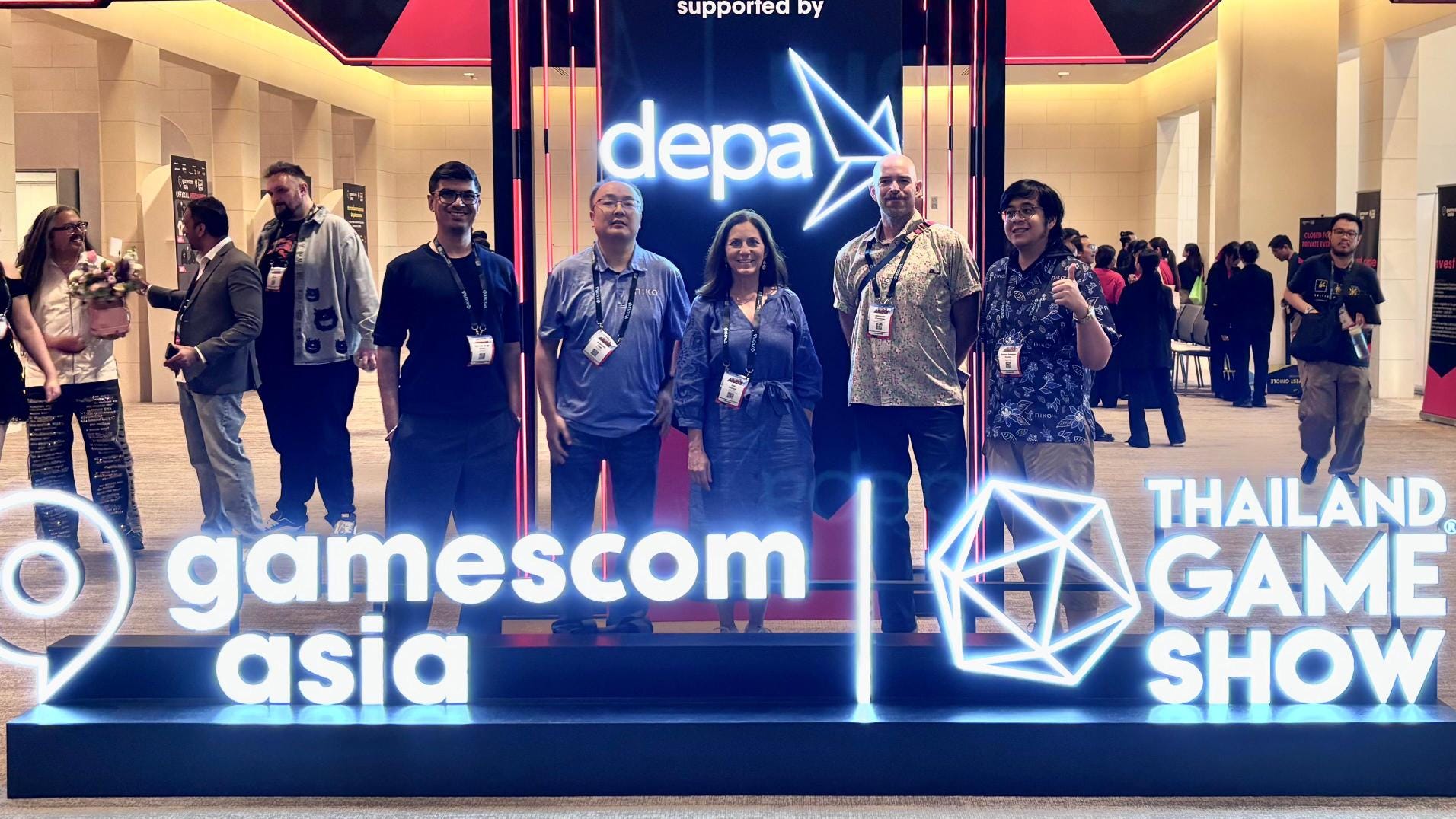
Gamescom Asia x Thailand Game Show 2026 attracted 219,546 attendees from 113 countries, reinforcing Thailand’s growing position as a regional hub for the video game industry. Held from October 29 to November 1 at Bangkok’s Queen Sirikit National Convention Centre, the four-day event occupied 38,519 square meters and was described by organizers as its most international edition to date. The event also attracted 720 media representatives, influencers and content creators, while livestreams and digital content generated nearly 34 million views across platforms, extending its reach beyond physical attendance.
The Niko Partners Senior Leadership Team, together with Niko’s Thailand Analyst, Nina Kitkrua, attended the event. We also launched our joint white paper with Xsolla: “Waking the Southeast Asian Giants: Players, Payments, and Localization in Three of Asia’s Most Exciting Markets“, which examines the growing significance of Indonesia, Thailand, and Vietnam, three of the key Southeast Asian markets tracked by Niko. Thank you to everyone who joined the panel and stopped for a chat throughout the event!
Why this matters: Exhibitor participation increased this year with 335 exhibitors and pavilions compared with 294 in 2025, representing 14% growth. International participants accounted for 64% of exhibitors, with representation from 29 countries, including 20 national pavilions and industry delegations. The event’s business segment attracted 6,923 visitors from 78 countries, representing 24% growth from 5,590 in 2025, with more than half traveling from outside Thailand. Attendees had access to 582 playable games, including 347 indie titles, which represented approximately 60% of the games showcased.
Niko Partners goes to Montreal International Game Summit
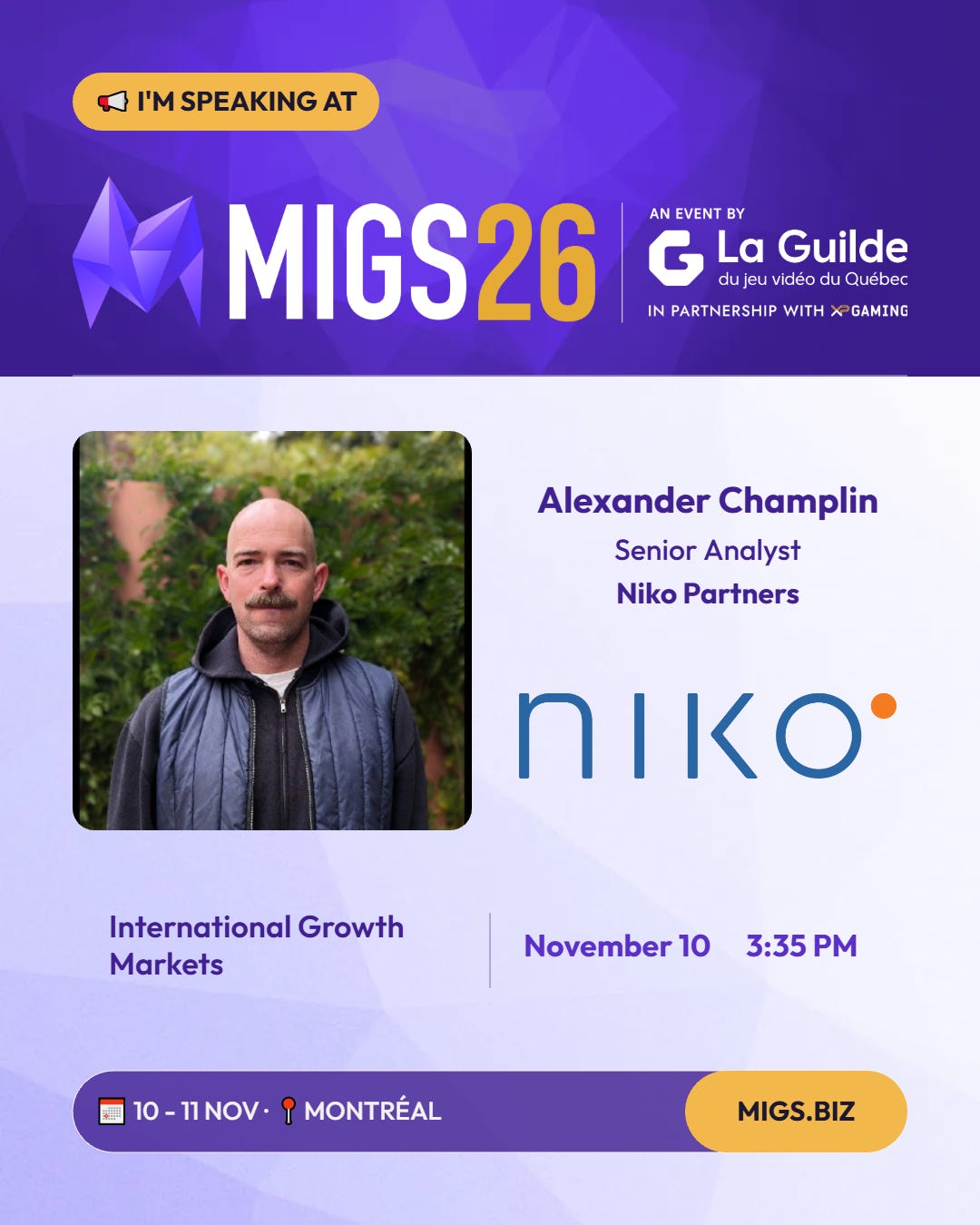
Niko Partners is heading to Montreal for MIGS on November 10-11. Niko’s Senior Analyst Alexander Champlin will share insights on the next wave of gaming growth across Africa, Latin America, and the Middle East on a panel titled “International Growth Markets”. See you there if you’re attending too!
MENA Sees Growth Through Localization, Increased spending, Esports
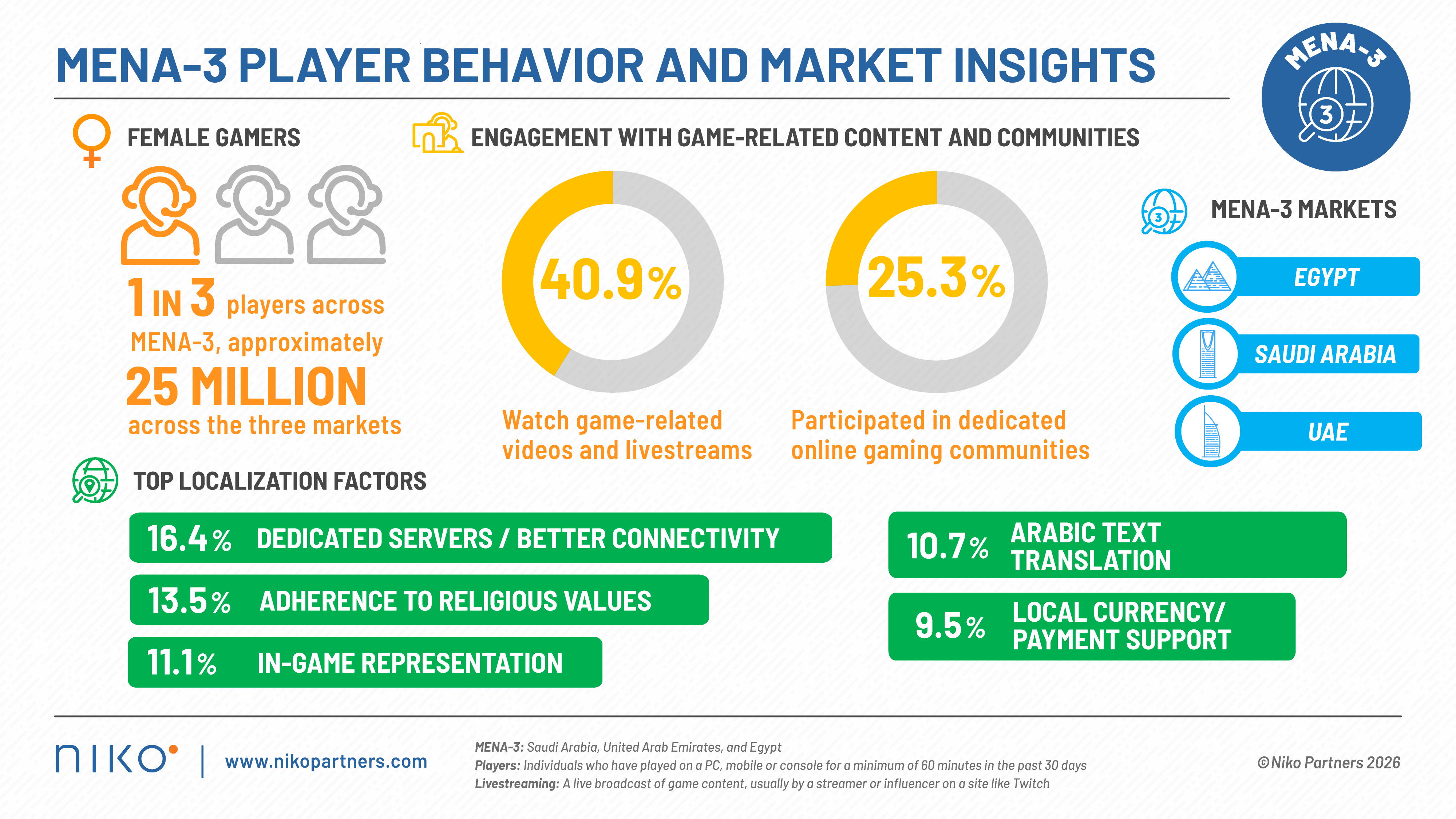
The MENA-3 markets (Saudi Arabia, UAE, and Egypt) generated $2.15 billion in gaming revenue in 2025 and are expected to reach $2.94 billion by 2030. Key trends shaping the market include strong government support for video games and esports, higher spending potentials through rapid ARPU growth, rising importance of culturally relevant localization.
As MENA’s player base matures and spending becomes increasingly concentrated among high-value users, publishers will need more targeted engagement and monetization strategies for success in the region. Learn more key takeaways from MENA-3 Player Behavior and Market Insights Reports here.
Waking Southeast Asian Giants - New white paper from Niko Partners and Xsolla
Southeast Asia is on track to become a $7 billion video games market by 2030, fueled by nearly 300M gamers and strong growth across the region. The region presents new opportunities for international video game developers looking to expand their reach and connect with more players.
Niko Partners and Xsolla team up to explore of Southeast Asia’s rising video games markets: Indonesia, Thailand, and Vietnam. Our new white paper explores the key opportunities, payment preferences, and strategies for success in these high-potential markets.
China approves 195 video games in October 2026
The National Press and Publication Administration (NPPA), mainland China’s regulator in charge of game approvals, issued ISBNs for 183 domestic games and 12 import games on October 28, 2026. This is the ninth batch of games approved in 2026 and takes total approvals to 1,707 domestic games and 58 import games. The domestic batch included 166 mobile games, 2 PC games, 1 console game, and 14 cross-platform games, while the import games list included 7 mobile game, 2 PC games, and 3 cross platform game. A total of 10 games were included on the updated ISBN list where publishers can request a name change, publisher change, or additional platform for an existing ISBN.
Key publishers that received licenses this month include Tencent, NetEase, 37 Interactive, Lingxi Interactive, Zlongame, Sunborn, Kingnet, 4399, and Yoozoo games among others. One approval was for a new entry in Sunborn’s Girls Frontline franchise title Girls’ Frontline Blue Butterfly Covenant, a PVE co-op shooter. Happy Elements also received a license for StarToU, an idol management game with rhythm elements. The most notable import game was Odin: Valhalla Rising from Lionheart Games, a subsidiary of Kakao Games.
Link to original article (Chinese) →
Garena launches localized Free Fire India more than four years after the game’s ban
Garena has relaunched Free Fire India more than four years after the game’s ban over national security concerns, launching it as a standalone title on Android and iOS. The localized version includes India-specific content, parental controls, playtime limits, spending caps, and player data hosting on servers located in India, while Garena said it worked with Indian authorities and incorporated regulatory feedback before launch. Garena also confirmed that Free Fire MAX, which remained available during the ban period, will continue operating alongside Free Fire India, with players able to use the same accounts, play together, and participate in shared events.
Why this matters: According to Sensor Tower data reviewed by TechCrunch, the Free Fire franchise recorded approximately 77.4 million monthly active users in India in June, compared with 20.8 million for Krafton’s Battlegrounds Mobile India (BGMI). India’s approval of a localized version of Free Fire highlights the growing importance of market-specific compliance, data localization, and player safety features for publishers operating in the country. The game’s return is likely to intensify competition in India’s mobile battle royale segment while creating new opportunities across esports, creator ecosystems, and live service monetization.
Tencent and NetEase remove Mbappe promotional content following controversial comments
Chinese game publishers Tencent and NetEase have announced measures to remove or suspend promotional content featuring French footballer Kylian Mbappe following controversy over comments he made about China. The incident highlights the reputational and commercial risks associated with using international athletes as promotional partners in the Chinese gaming market. The controversy began after a video circulated online showing Mbappe discussing an internet meme that depicted his face superimposed onto an image of Mao Zedong. According to Australian broadcaster ABC, Mbappe referred to Mao as a “Chinese dictator” while explaining the image, prompting criticism from Chinese audiences.
Why this matters: While Mbappe issued an apology, several Chinese sponsors reportedly ended their partnerships with Mbappe following the controversy. The incident shows how celebrity marketing and status is viewed in China and how backlash can lead to both bottom up and top down pressure for companies and sponsors to take action, with this case leading to EA and Konami removing promotional campaigns and live service content. The situation also demonstrates how events outside the gaming industry can directly affect game operations, marketing strategies and relationships with international sports personalities.
KCC fines Google and Apple under South Korea’s anti-forced in-app payment law
Korea’s Korea Communications Commission (KCC) imposed fines of KRW 42.9 billion ($30.6 million) on Google and KRW 20.81 billion ($14.9 million) on Apple for violating the Telecommunications Business Act through practices that restricted developers’ payment options. The case marks the first enforcement action under Korea’s law prohibiting app marketplace operators from forcing specific in-app payment methods. Although both companies formally permitted third-party payments, the KCC found they effectively discouraged their use through fees of up to 26%, procedural restrictions, and limitations on functionality.
Why this matters: The KCC ordered both companies to support alternative payment options, including external payment links within apps, adjust third-party payment fees, revise app review procedures, submit implementation plans within one month, and complete service improvements within three months; no criminal referrals were issued. Korea continues to lead global efforts to regulate app store payment practices, and this first enforcement action under the anti-forced in-app payment law demonstrates regulators’ willingness to challenge platform policies that indirectly discourage alternative payment systems.
Link to original article (Korean) →
Phantom Blade Zero sells 4 million copies in three days
Chinese developer S-Game has confirmed that Phantom Blade Zero has sold more than 4 million copies in its first 72 hours, while also reaching 834k concurrent players on Steam, making it one of the most successful game launches this year. Niko Partners estimates that over 3 million units were sold in China, with the title ranking at #3 by viewers on our China Games & Livestreaming Tracker, behind Honor of Kings and League of Legends. S-Game and PlayStation have been heavily promoting the game in China, with marketing efforts including roadshows, brand partnerships and TV commercials.
Why this matters: Like Black Myth: Wukong, the strong launch of Phantom Blade Zero is another example of a Chinese developer finding success in the AAA premium game space with a new IP. It also shows how China has developed as a serious market for AAA games with multiple premium titles becoming million sellers over the past few years. S-Game previously created Rainblood and Phantom Blade titles, which are set in the same universe as Phantom Blade Zero.
Indonesia plans expanded digital tax collection framework with potential implications for digital games
Indonesia plans to implement a digital tax collection framework beginning November 9, 2026, under which state-owned and private banks, fintech firms, and digital marketplaces would participate in tax collection and remittance. According to Hashim Djojohadikusumo, Chair of the Advisory Board of the Indonesian Chamber of Commerce and Industry (Kadin), who is also the brother of Indonesia’s current president, the initiative aims to improve collection of taxes from digital transactions that have not previously been fully captured. The policy is motivated by Indonesia’s state revenue ratio of approximately 12% of GDP, including tax, excise, and non-tax revenue, which is lower than that of several regional peers. Digital games and in-game content are among the digital products that may fall within Indonesia’s broader digital taxation framework.
Why this matters: Indonesia’s expanded digital tax collection framework could increase compliance requirements for game publishers, platform operators, and payment providers serving the market. The country has been increasing regulations affecting the games industry in the past few years, such as through the Electronic System Regulations (PSE) and Indonesia Games Rating System (IGRS), both of which face issues and criticisms in the implementation.
Link to original article (Indonesian) →
AI is no match for Niko’s on-the-ground analysts and data gathering methods.
Valorant surpasses 100 million registered users in China
Riot Games has announced that Valorant surpassed 100 million registered users on its Chinese servers. The milestone builds on strong growth across the Valorant franchise in China, where Tencent operates both the PC and mobile versions. Tencent previously disclosed that the two games had exceeded a combined 50 million monthly active users (MAUs) by the end of 2025. The PC version surpassed 2 million daily active users (DAUs), while Valorant Mobile exceeded 10 million DAUs, highlighting the franchise’s ability to reach audiences across multiple platforms.
Why this matters: The achievement also follows China’s hosting of VALORANT Champions, reinforcing the country’s growing importance within Riot Games’ global esports ecosystem. Although Chinese teams have faced challenges achieving consistent international results, domestic player engagement and interest in the franchise remain strong. According to our China Games and Livestreaming Tracker, Valorant PC was the #5 most viewed title in the past month while the mobile version charted at #35. The combination of competitive gameplay, localized operations, esports investment and crossplatform brand recognition has helped Tencent and Riot reach a broader audience in China.
Dragon Ranger Gaming to develop Esports Hotel complex in Beijing
Chinese esports organization Dragon Ranger Gaming (DRG) has signed an agreement to develop an esports hotel complex in Beijing’s Shijingshan District, as local authorities continue investing in gaming and esports infrastructure. The agreement was formalized on October 24 during the opening ceremony of the 2026 Jingxi Esports Festival, reflecting efforts to expand the district’s esports ecosystem and attract industry investment. Shijingshan District has emerged as a growing gaming and esports hub, hosting 135 gaming and esports-related companies generating more than RMB 24.81 billion ($3.72 billion) in combined annual revenue.
Why this matters: Local authorities have introduced dedicated industry support measures to attract businesses and strengthen the sector’s development. The opening of the Shougang Park Esports Center in March 2026 further expanded the district’s infrastructure, providing a specialized venue for competitive gaming events and related activities. Founded in 2016, DRG relocated to Shijingshan District in June 2025 as part of the area’s broader industry development strategy. The organization operates competitive teams across multiple titles, including Honor of Kings, VALORANT, Delta Force, Naraka: Bladepoint and The Finals.
Tencent to shut down Pokémon Unite
Tencent’s TiMi Studio Group and The Pokémon Company have announced that Pokémon Unite will shut down globally in 2027, ending operations for the free to play MOBA game after more than five years. The Chinese mainland version will close on January 28, 2027, while services in other markets will end on March 23, 2027. Co-developed by Tencent and The Pokémon Company, Pokémon Unite launched on Nintendo Switch in July 2021, followed by mobile devices in September 2021. The game subsequently launched in mainland China in November 2024. It became a notable example of Tencent’s international expansion strategy, combining a globally recognized Japanese intellectual property with the company’s expertise in competitive multiplayer and mobile game development.
Why this matters: Pokémon Unite exceeded 70 million downloads across platforms within its first year and surpassed 200 million cumulative downloads worldwide by July 2025, according to its fourth-anniversary announcement. Niko Partners estimates the title grossed over $150 million across both platforms, but that monthly revenue had recently fallen under $1 million per month. While an official reason for the shut down was not disclosed, we believe the games commercial performance and a lack of renewal for the license were the main contributors. The closure also follows the termination of online services for Tencent’s officially licensed mainland Chinese Nintendo Switch on May 15, 2026, marking another change in the companies’ longstanding relationship.
Link to original article (Chinese) →
GPU prices continue to soar in China
Prices of high-end consumer GPUs have risen sharply in China, driven by supply constraints linked to growing demand for AI data center infrastructure. Retailers report that price increases have accelerated in recent weeks, with shortages of components used in both consumer and enterprise hardware contributing to reduced GPU availability. Nvidia’s RTX 5060 is reportedly selling for approximately RMB 4,000 ($600), while the RTX 5070 is priced around RMB 8,000 ($1,200), with some variants exceeding RMB 9,000 ($1,350). Higher-end models have experienced particularly significant increases, with the RTX 5090D reaching approximately RMB 30,000 ($4,500) and the banned RTX 5090 exceeding RMB 50,000 ($7,500).
Why this matters: We note the RTX 5060 was available for RMB 2,000 ($300) earlier this year before increasing to RMB 3,000 in the past month and now reaching RMB 4,000 this week. Local merchants attribute the increases to competition for components used in AI data centers, which has constrained consumer GPU production and shipments. Retailers expect high-end GPU prices to remain elevated or increase further in the near term, while lower-end discrete graphics cards and other PC components have experienced relatively limited price changes. Most hardcore gamers aspire to own an RTX 5060 or higher, highlighting the growing affordability challenge for mid to high end PC gaming and the need for developers to optimize games for older GPUs.
Moonton and Qiddiya expand partnership for 5 more years
Prices of high-end consumer GPUs have risen sharply in China, driven by supply constraints linked to growing demand for AI data center infrastructure. Retailers report that price increases have accelerated in recent weeks, with shortages of components used in both consumer and enterprise hardware contributing to reduced GPU availability. Nvidia’s RTX 5060 is reportedly selling for approximately RMB 4,000 ($600), while the RTX 5070 is priced around RMB 8,000 ($1,200), with some variants exceeding RMB 9,000 ($1,350). Higher-end models have experienced particularly significant increases, with the RTX 5090D reaching approximately RMB 30,000 ($4,500) and the banned RTX 5090 exceeding RMB 50,000 ($7,500).
Why this matters: We note the RTX 5060 was available for RMB 2,000 ($300) earlier this year before increasing to RMB 3,000 in the past month and now reaching RMB 4,000 this week. Local merchants attribute the increases to competition for components used in AI data centers, which has constrained consumer GPU production and shipments. Retailers expect high-end GPU prices to remain elevated or increase further in the near term, while lower-end discrete graphics cards and other PC components have experienced relatively limited price changes. Most hardcore gamers aspire to own an RTX 5060 or higher, highlighting the growing affordability challenge for mid to high end PC gaming and the need for developers to optimize games for older GPUs.
Events
Montréal International Game Summit (MIGS)
November 10-11, 2026
Montreal, Canada
Speaker: Alexander Champlin
G-Star
November 19-21, 2026
Busan, South Korea
Attendee: Shin Young Kim