

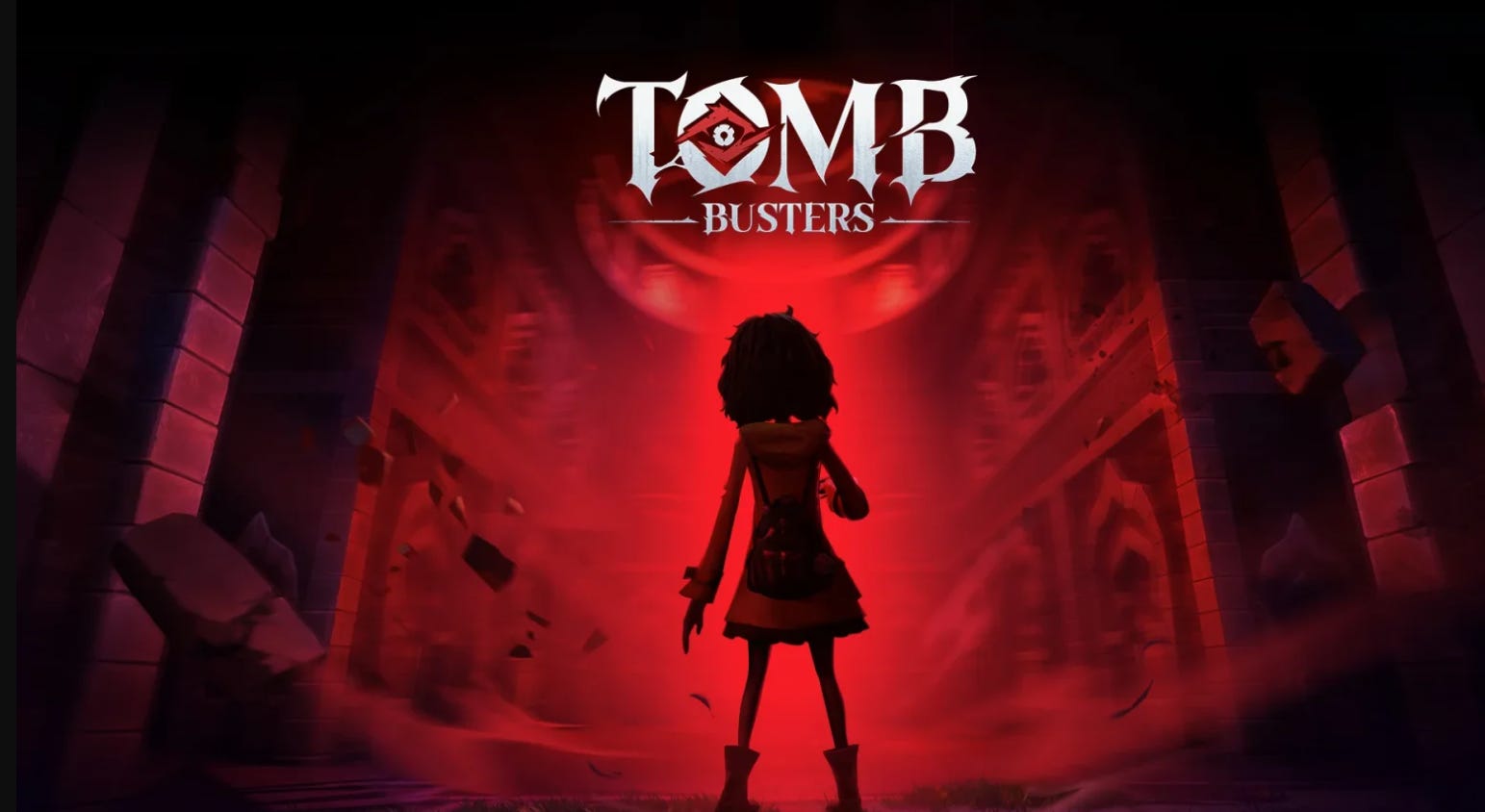
Giant Interactive has launched Tomb Busters outside Asia for the first time following the title’s breakout success in China. Originally released domestically in January 2025, the free to play mobile game has surpassed 200 million downloads, 10 million DAUs, and generated more than 140 billion social media views in China. Tomb Busters blends extraction style gameplay with cooperative horror mechanics inspired by themes rooted in Chinese local folklore. Players explore ancient tombs either solo or in four player groups while navigating traps, supernatural threats, random events, and puzzle mechanics. The game was specifically designed to balance tension and fear during solo play with the addition of comedic moments and group chaos during multiplayer sessions.
Why this matters: The title’s popularity has had a notable ripple effect across China’s live service ecosystem. Multiple major games including Identity V, Justice Online, Eggy Party, Peacekeeper Elite, and Party Stars have introduced their own Tomb Busters inspired limited modes following the game’s viral growth. The title has also drawn comparisons to Lethal Company due to its cooperative social gameplay structure, though Tomb Busters differentiates itself through mobile accessibility, Chinese horror aesthetics, and AI driven NPC systems capable of mimicking human behavior and interacting dynamically with players. The game has done extremely well with younger and female audiences, and its social gameplay dynamics have helped create viral moments on social media and livestreams.
Asia & MENA video game revenue will pass $100 billion by 2030
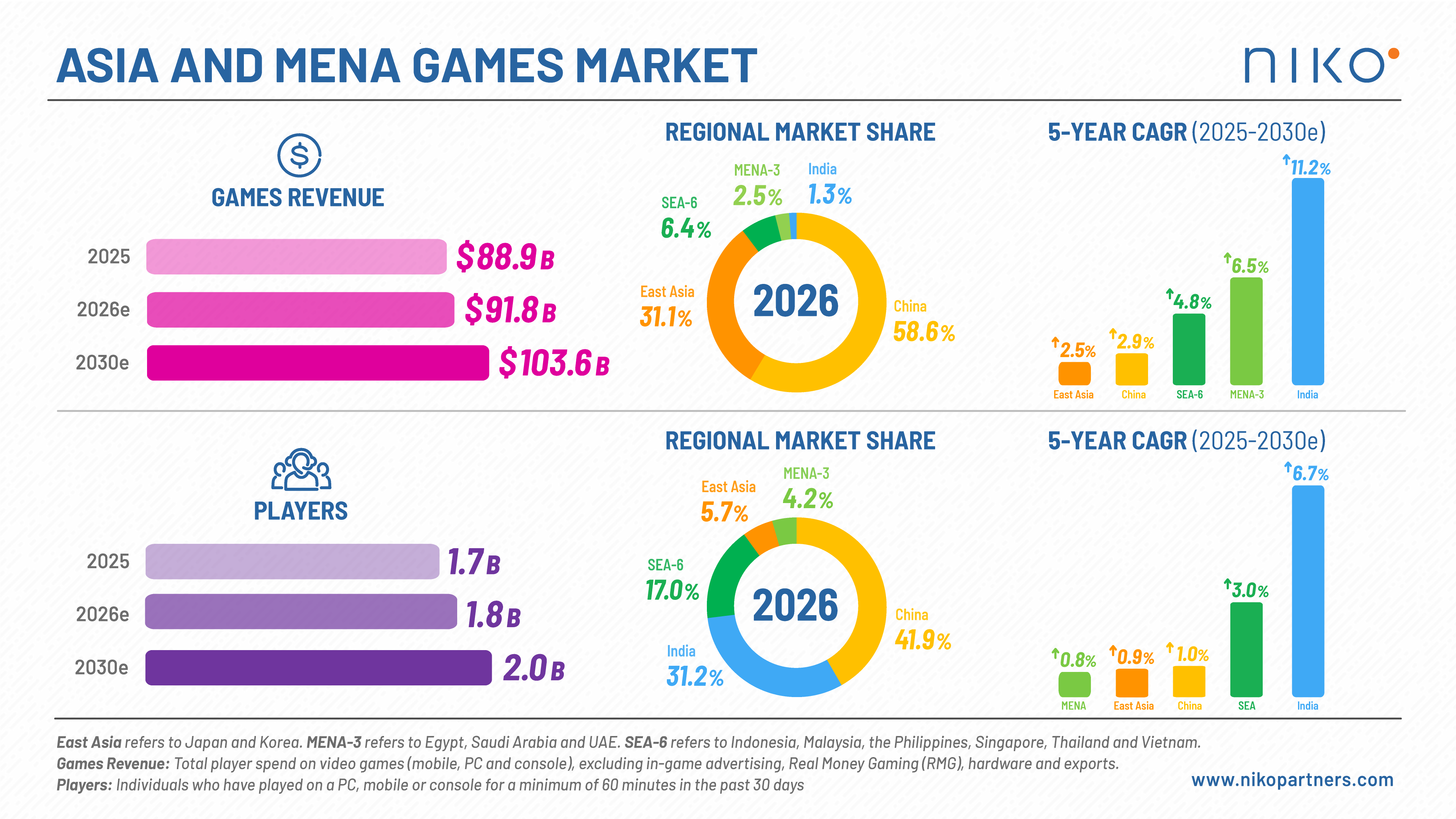
Niko’s 2026 market model with forecast through 2030 shows player spending on video games in Asia & MENA increased at a faster pace in 2025 compared to the prior year, and the market continues to demonstrate resilience and long-term growth potential amid ongoing geopolitical uncertainty, shifting trade policies, and broader economic volatility impacting industries worldwide.
The Asia and MENA video games market generated revenue of $88.9 billion in 2025, up 2.6% YoY. Looking forward, growth looks even stronger, with the market projected to climb 3.4% in 2026 to $91.8 billion, and reach $103.6 billion in 2030, at a 5-year CAGR of 3.1%.
Read our post and download extensive key takeaways here.
Sony launches new marketing campaign for PS5 in China
Sony Interactive Entertainment has launched a new China focused PlayStation 5 marketing campaign titled “The Show Happens on PS5,” centered around football to align with the upcoming FIFA World Cup. The campaign features well known Chinese sports commentator Guan Zeyuan joining Sony’s PlayStation Playmaker ambassador program. The advertising initiative positions PS5 as both an immersive gaming platform and a social entertainment device connected to sports fandom, competition, and family interaction.
Sony stated that the “PlayStation Football Carnival Season” campaign will run from May through July and include both online and offline activations integrating football culture with interactive entertainment experiences.
Why this matters: Sony’s use of sports culture, influencer integration, and offline activations also reflects the growing importance of localized cultural marketing in China, where social engagement and experiential events are becoming increasingly important for driving hardware relevance and ecosystem loyalty. The company plans to promote the campaign across major Chinese social platforms including Weibo, WeChat, Bilibili, Douyin, and Xiaohongshu. However, the campaign comes at a time when Sony has just increased PlayStation 5 prices.
Link to original article (Chinese) →
WeChat Mini Games ecosystem surpasses 500m MAUs
Tencent held the 2026 WeChat Mini Games Developer Conference in Hangzhou this week, where the company revealed new data and insights on the mini game ecosystem. According to Tencent, the number of WeChat mini game developers reached 500,000 in 2025, up from approximately 400,000 in 2024. Monthly active users surpassed 500 million, further cementing WeChat Mini Games as one of the largest gaming ecosystems globally. Female players now account for 47% of total users, while people aged 24 to 40 represent roughly half of the audience. Notably, users over the age of 40 account for another 40%, highlighting the category’s unusually broad demographic reach compared to traditional mobile gaming segments.
Why this matters: Tencent stated that the platform’s strategic focus is shifting away from simply maximizing user scale toward increasing retention, extending playtime, and expanding genre adoption across different devices and monetization structures. Average daily usage time per user exceeded 60 minutes, reflecting increasingly deep engagement levels. Tencent stated that more than 80% of minigame developers are small and medium sized teams with fewer than 30 employees, while many projects initially begin with only three or four developers. Company executives suggested AI tools may increasingly allow even individual creators to build commercially viable games in the future.
Link to original article (Chinese) →
World of Tanks: Heat sees negative reviews across the board
Wargaming officially launched World of Tanks: Heat on Steam on May 26, 2026 following more than four years of development. Built on a new proprietary engine, the hero driven tank action title attracted significant early interest from veteran World of Tanks players due to its upgraded graphics and faster paced gameplay structure. China quickly emerged as the game’s second largest market by review volume, accounting for 21% of total Steam reviews. However, approximately 80% of Chinese reviews were negative, with criticism centered around monetization, progression pacing, and technical optimization. Global reviews were also fairly negative.
Why this matters: Chinese players described progression as excessively grind heavy, with low currency acquisition rates and high unlock requirements for tanks, agents, upgrades, and equipment systems. Some players estimated it could take hundreds of matches to unlock new content without spending money, leading to accusations that the game strongly pressures users toward monetization despite positioning itself as a more accessible, fast paced experience. Technical performance issues further amplified frustration, with reports of unstable framerates, stuttering, and crashes even on relatively capable hardware configurations.
Link to original article (Chinese) →
Monetary stakes on ‘uncertain outcomes’ is gambling, says India’s Supreme Court
India’s Supreme Court, in a judgement on several cases between state governments and real-money game (RMG) operators, has said that monetary stakes on ‘uncertain outcomes’ counts as gambling, whether the underlying game is a game of skill or game of chance. ‘Online gaming operators are not mere intermediaries facilitating transactions...but themselves constitute suppliers of such actionable claims within the framework of CGST (Central Goods & Services Tax) claims, the Court said while pronouncing its judgement on four cases.
Why this matters: While the ruling should have no direct impact on video games, it is another setback for real-money game companies who had filed a motion with the Supreme Court against retrospective tax claims by the government. Given the ban on RMG in August 2025, it is likely that many RMG companies will not have the funds necessary for paying these claims. We believe video game companies should remain aware of these developments, particularly as regulations around video games (dubbed ‘social games’ and ‘esports’ by the recent PROG Rules) evolve to address matters such as lootboxes, tournament prize pools, and related topics.
Cygames renews title sponsorship of France’s Grand Prix de Paris horse race
Cygames announced on May 28 that it will continue its partnership with France Galop as the title sponsor of the Grand Prix de Paris horse race for a second consecutive year, with the race again branded as the “CYGAMES GRAND PRIX DE PARIS.” As part of the agreement, the Umamusume Pretty Derby publisher will receive prominent on-site branding across race programs, starting gates, track boards, and saddle towels, and will also sponsor two additional races on the same day.
Why this matters: Cygames’ sponsorship of a major European horse race event highlights how Japanese game companies are expanding global brand visibility beyond traditional marketing channels. This reflects a broader trend of leveraging cross-media IP with notable real-world counterparts such as Cygames’ horse racing game Umamusume, to reach mainstream audiences and strengthen international positioning. The game also had a pop-up at the 2025 Kentucky Derby.
Link to original article (Japanese) →
Qiddiya City partners with MPL MENA to scale esports ecosystem in the region
Qiddiya City has entered a five-year partnership with Mobile Legends: Bang Bang Professional League (MPL) MENA, becoming the league’s Official Partner to support esports growth through broadcasts, events, and grassroots programs, with MPL MENA organized by Moonton Games. The announcement coincided with the MPL MENA Season 9 Grand Finals in Cairo, which achieved 91,542 peak viewers and sold out 3,000 seats, signaling strong demand for live esports in the region. Geekay Esports won the championship, securing a place in the 2026 Esports World Cup Mid-Season Cup. This was followed by Saudi’s Team Falcons advancement to the Wild Card stage.
Why this matters: Qiddiya is developing a 500,000 sqm Gaming and Esports District with multiple arenas, aiming to host large-scale tournaments, attract up to 10 million annual visits, and house up to 25 esports clubs. Qiddiya’s investment signals accelerating state-backed esports infrastructure development in MENA, positioning the region as a global events hub. Moonton’s Mobile Legends: Bang Bang has emerged as a leading MOBA esports game on mobile in both Southeast Asia and MENA, and is also growing in popularity in Latin America as well.
Niko consumer insights and business intelligence dives deeper than AI.
Lisuan Tech sells out 30,000 preorders for its first gaming GPU
Lisuan Technology has sold out of its 30,000 pre orders for its LX 7G100 consumer graphics card in China ahead of launch. The GPU is priced at $485 and represents one of the country’s most serious attempts to establish a domestically developed gaming graphics card ecosystem. The strong pre-order performance comes despite early benchmark reviews showing the LX 7G100 substantially trails competing products from Nvidia, AMD, and Intel in gaming workloads. Testing reportedly showed Nvidia’s GeForce RTX 4060 outperforming the LX 7G100 by roughly 20% to 70% depending on the title. The launch also reflects the increasing visibility of “domestic substitution” trends within China’s consumer electronics market.
Why this matters: While the card is capable of running mainstream AAA and online games at playable frame rates, driver maturity, software optimization, and ecosystem compatibility remain major weaknesses for all Chinese GPU manufactures relative to global incumbents. Nevertheless, the sellout demonstrates a meaningful level of consumer curiosity and willingness among Chinese buyers to support emerging domestic hardware brands, particularly amid growing geopolitical tensions and restrictions around advanced semiconductor technology. Chinese firms are likely to continue receiving policy support and consumer attention even when performance lags established competitors.
Square Enix restarts dev on Dragon Quest XII, changes subtitle to Beyond Dreams
In a stream on May 27, Square Enix announced that it has restarted development on Dragon Quest XII, along with updating its subtitle from Flames of Fate to Beyond Dreams. The game was first announced in 2021 and was set to have a darker tone than the previous titles. While there have been few details yet about the game, Yuji Horii, the creator of the franchise and game design lead on XII, stated that the new title will feature the adventures of a protagonist experiencing mysterious dreams. Footage of the game was also revealed during the stream.
Why this matters: Dragon Quest is one of the most popular video game franchises in Japan, but its long development cycles, in line with much of the industry, could see its popularity diminish among younger gamers. Square Enix’s focus on remakes, such as Dragon Quest I and II HD-2D, have partially ameliorated this exposure issue, but with XII restarting development five years after its initial announcement, it is unlikely it will release before a decade has passed since its predecessor, XI‘s, release in 2017, highlighting the extent that development cycles have prolonged in the intervening generation.
Link to original article (Japanese) →
Events
Unreal Fest
June 16-18, 2026
Chicago, USA
Speaker: Alexander Champlin