


As the video game industry surpassed $190 billion in spending across game software and services last year, it’s no secret that evergreen games, aka forever games, have contributed to that high value. A natural evolution of Games as a Service, evergreen games are built around exceptional replayability with no fixed endpoint, allowing players to stay engaged for months or years. These games have also expanded into pan entertainment sectors including esports, transmedia, community creation and more.
Niko Partners reviewed the recent earnings reports of publicly traded game publishers with titles included in the list of evergreen games that are the basis of our new white paper, The Impact of Evergreen Games on the Global Market.
This post connects the dots between the importance of the titles mentioned in company earnings reports and the information Niko conveys in the white paper about the evolution of evergreen games. While other segments of the games industry are also growing and are also healthy, the qualities that have given rise to a growing list of evergreen titles are now key for all in the games industry to understand and learn from.
What is an Evergreen Game?
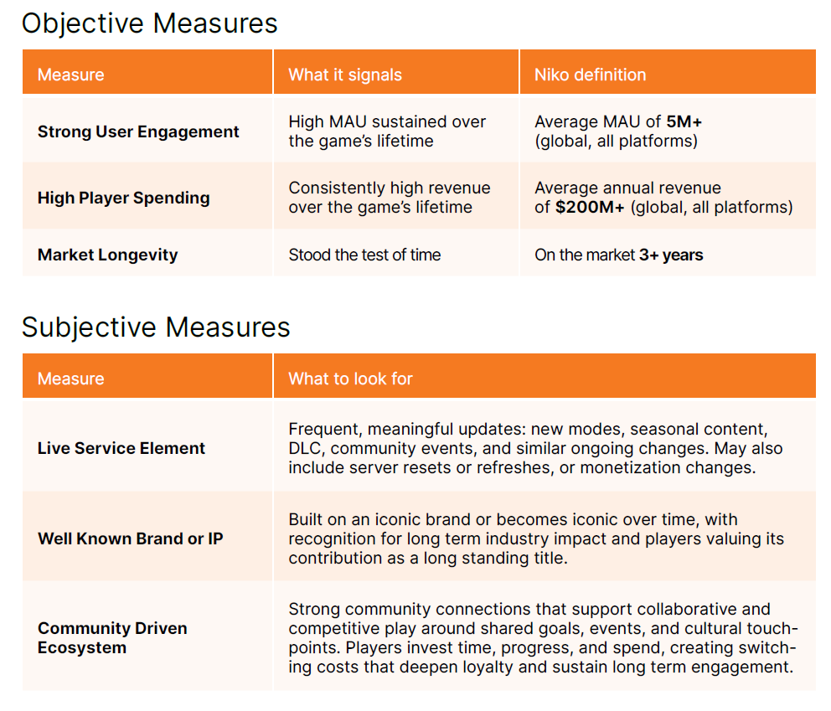
Niko Partners defines an evergreen game by:
High player spending, or consistently high annual revenue over the game’s lifetime.
Strong user engagement, or a high, sustained monthly average user (MAU) count over the game’s lifetime.
Market longevity, having stood the test of time as a longstanding title.
A live service element that includes frequent meaningful updates over time.
Community-driven ecosystem, or high-value social connections between a game’s players that are actively driven by a games’ developer through shared goals and social touchpoints that then positively influence the above two factors.
Evergreen games also allow companies to distinguish between their live-service and ‘traditional’ portfolios, which then allows for unique applications to both. As a result, many traditional publishers have shifted to reporting recurrent spend (e.g., subscriptions, battle passes, and in-game purchases) alongside full game sales, with recurrent revenue now accounting for a larger share of the overall pie. In some cases, particularly in Asia, publishers report recurrent spending as their primary metric, without the need to track full game sales or other legacy metrics like packaged software sales.
Evergreen Games reflected in FY 2025 earnings results of key public companies
To show some examples, Niko has pulled data from 4 publicly traded publishers with evergreen games, 3 from Asia and 1 from the United States.
TENCENT:
Tencent’s online games business saw revenue jump 22% YoY in 2025, driven by the ongoing success and expansion of its evergreen games. An increased commitment to Valorant in China, which included new character skins, limited time modes, and major esports events, led to the game seeing a 30% YoY bump in player spending with average DAUs hitting a record high.
In fact, Tencent was one of the first companies to highlight the role of evergreen games within its strategy. In its Q3 2023 earnings report, the company stated “Our games strategy is built around evergreen games” that are “popular and successful” over the long term, rather than titles with a finite “product cycle that age and then require heavy rejuvenation”. Today, Tencent claims it has 14 evergreen titles that meet its own internal definition, while we have identified 13 that fit our definition.
SEA, LTD:
For Sea Ltd, its games business (Garena) also saw a significant 37.3% YoY increase. While new game launches played a role, it was battle royale game Free Fire that contributed to most growth thanks to new maps, collaborations with Korean and Japanese IP, and over 600,000 players worldwide competing in the Free Fire World Series tournament. Free Fire has now seen two consecutive years of bookings growth greater than 30%, and 2025 bookings were nearly double those recorded in 2023.
Looking at these numbers and the reasons behind their growth, both Tencent and Garena have actively focused on growing their paying user base as well as increasing engagement via regular and timed content updates that have resulted in a positive feedback loop for revenue.
NEXON:
Other companies have applied different approaches to growing their evergreen portfolios. Nexon, for example, saw revenues for its MapleStory franchise increase 43% YoY, thanks to an expansion into new genres with titles like MapleStory: Idle RPG. Nexon is also the parent company of Embark Studios who are behind Arc Raiders which has “sustained strong player engagement and sales momentum with monthly content drops and live events” and could become a long-term hit.
TAKE TWO:
The Grand Theft Auto franchise is a notable example of an IP traditionally associated with a finite experience evolving into a modern evergreen game. While previous entries like Grand Theft Auto IV sold more than 25 million copies in five years and included unique multiplayer modes, the title was never designed to offer a consistent live service experience. By contrast, Rockstar’s observations of mobile live service trends resulted in GTA V launching alongside a continuously evolving online world.
This has resulted in the franchise having “vastly outpaced” Take-Two Interactive’s forecasts, recording repeated consumer spending growth of 27% as of the company’s Q3 results for its 2026 fiscal year. Full game sales have also seen a boost as a result of this longevity, growing from 30 million in 2013 to over 225 million today, and the company has unlocked an additional revenue stream with its GTA+ subscription with “membership levels nearly doubling over the same period last year”.
Outlook for evergreen games
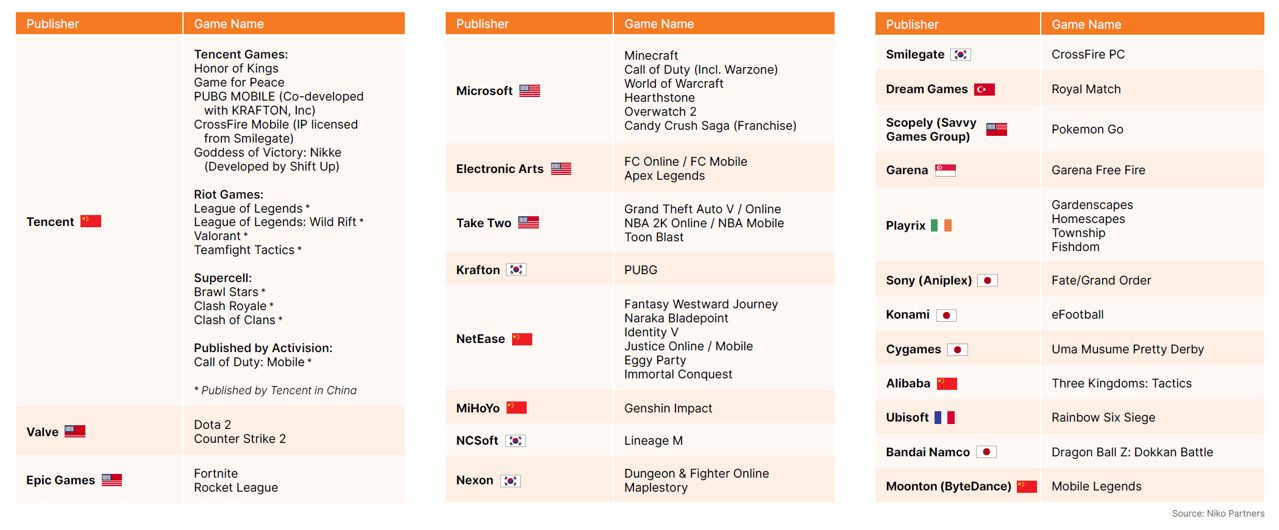
In Niko’s observation, many of the evergreen games in the market come from Asian publishers, and we wanted to explore that with this white paper, having identified more than 60 titles that meet our evergreen criteria. Niko’s 2025 Gamer Survey also found approximately 62% of players across Asia & MENA are motivated to play games that directly align with evergreen game characteristics. As evergreen games mature, growth is also being driven by expanding beyond the core gameplay experience with esports, livestreaming, and transmedia initiatives extending IP visibility, diversifying revenue streams.
Transmedia initiatives have become an especially notable way for video game companies to reach non-players, reactivate lapsed users, grow cultural visibility, and drive revenue growth both in and out of the game. A Minecraft Movie is one such example, with the film grossing over $960 million at the global box office thanks in part to the game’s cross-generational appeal.
UGC is another area of expansion. Several titles have noticed the success of Minecraft and Roblox and included UGC within their game clients, including Fortnite and PUBG Mobile. Asian video game companies, notably those in China and Korea, have also begun using AI to validate and produce content at a quicker pace, though we note that companies are careful to not dilute core gameplay loops or produce content that doesn’t match player expectations of what the game should contain.
Watching the evolution of live-service into evergreen games has prompted us to write this white paper with three primary goals in mind: defining an evergreen game, charting the reasons behind their rise over the past two decades, and providing insight on why such titles are highly favored by players across markets.
Please download Niko’s new white paper, The Impact of Evergreen Games on the Global Market, for FREE here.
Niko Partners will continue tracking the development and evolution of evergreen games, including player response and engagement with these titles and portfolios as more companies attempt to replicate the success existing titles have seen. Our suite of market and online tools, along with our bespoke consulting services, can help examine broad and specific topics within this and other developments that are shaping video game markets across Asia & MENA. We invite you to speak with us.