

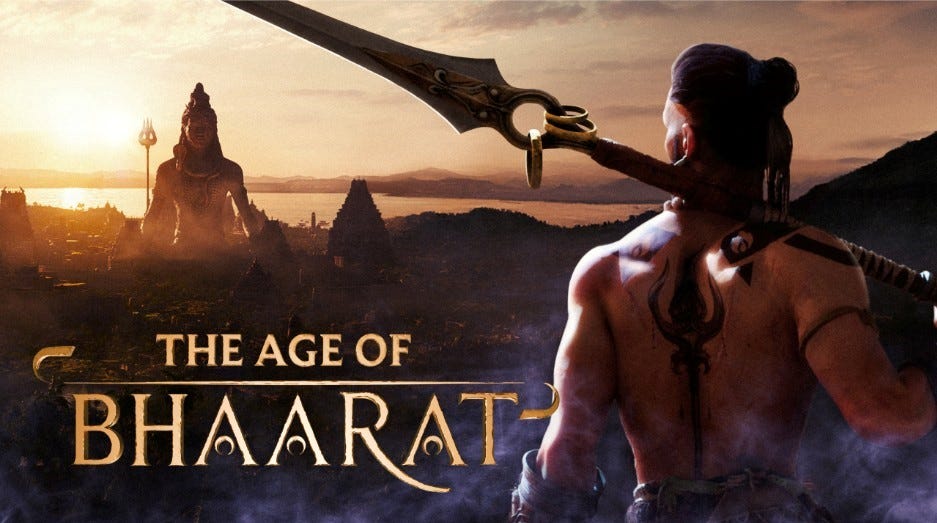
Indian developer Tara Gaming is positioning itself to create a globally successful AAA game with The Age of Bhaarat, a PC and console action title inspired by Indian mythology and culture. The studio aims to achieve for India what Black Myth: Wukong accomplished for China by demonstrating that locally developed, culturally rooted games can succeed with international audiences. Tara Gaming has assembled a team of more than 160 developers to support the project, led by former Ubisoft executive Nouredine Abboud, previously head of the Ghost Recon franchise, alongside filmmaker Amitabh Bachchan and bestselling author Amish Tripathi.
Why this matters: While our data shows India surpassed 500 million gamers in 2025 and player spending exceeded $1 billion, PC and console development remains relatively limited compared with mobile. This will be a challenging task for the studio who will primarily focus on overseas audiences. The game also aligns with the Indian government’s broader ambition to establish the country as a global game development hub while promoting Indian culture through interactive entertainment. Success would not only validate India’s AAA development ambitions but could also encourage greater investment into PC and console game production.
Esports World Cup 2026 in Paris, France opening ceremony features contemporary French musical artists
The Esports World Cup 2026 has begun in Paris, France with a bombastic Opening Ceremony at La Seine Musicale. The event will bring together more than 2,000 players and 200 esports clubs from over 100 countries. The prize pool will be $75 million. The seven-week competition features 25 tournaments across 24 of the world’s most popular games. The event was originally scheduled to be held in Riyadh, like last year, but had to move to Paris due to the 2026 Iran War. At a press conference on July 8, Esports World Cup Foundation CEO Ralf Reichert revealed that 100,000 tickets have already been sold.
Why this matters: Given the recent flare up in tensions between the US and Iran, it’s clear that moving to Paris was the right decision, a move that likely would have happened at some point given the organizers desire to hold the cup across multiple cities in the future. Fans in 160 countries will be able to follow the Esports World Cup live across 100 broadcast and OTT partners, streaming platforms and digital services, with more than 7,000 hours of live programming produced throughout the competition. Coverage will be available in more than 40 languages.
Livestreaming Tracker June 2026 Highlights: Tencent’s Shooter Portfolio Leads China’s Livestreaming Rankings
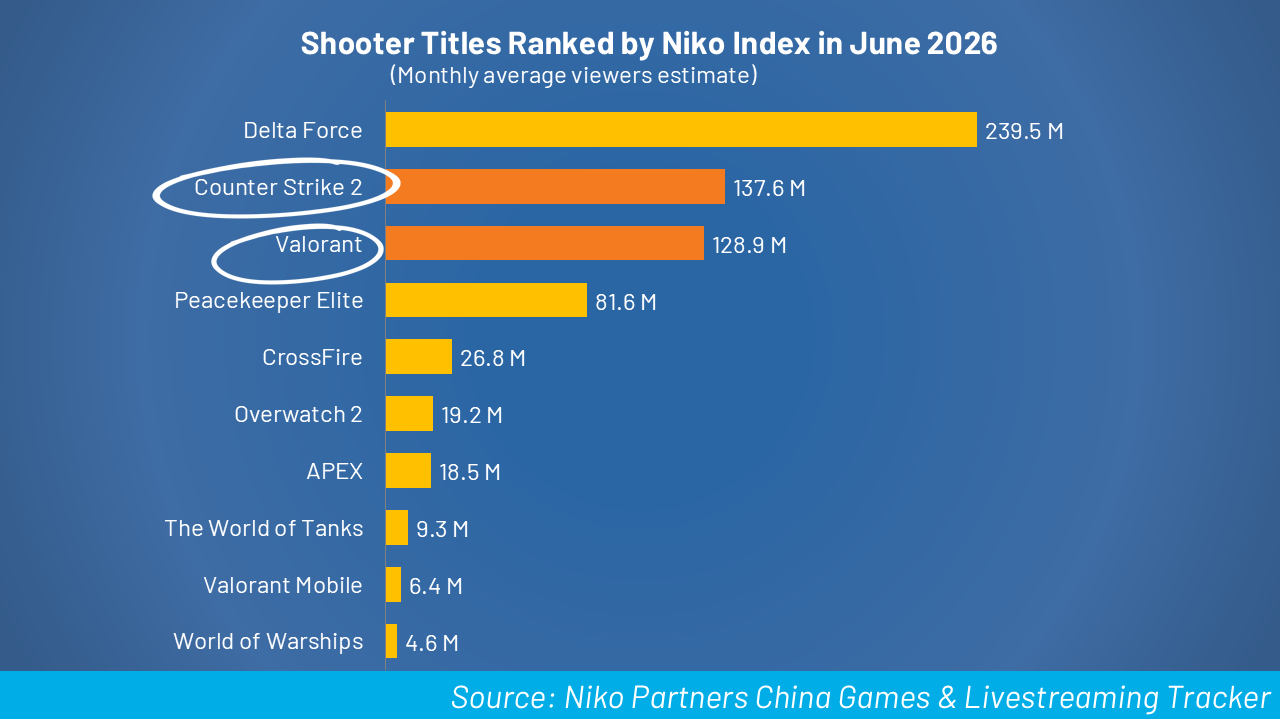
Shooter titles dominated China’s livestreaming landscape in June 2026, standing out as some of the month’s most-watched content. The hike was driven by global esports events, notably Counter-Strike 2 at IEM Cologne and Valorant at Masters London. Read the highlights here.
Chinese firms remove AI companion features ahead of new regulation
ByteDance, Tencent, and Alibaba are simultaneously removing AI companion features from their flagship chatbot platforms as China prepares to implement new regulations governing humanlike AI services. The decision has prompted backlash from users, many of whom have filed complaints and requested mechanisms to export conversation histories, memories, and character data after investing thousands of hours interacting with AI companions. The new regulations will strengthen oversight of AI systems capable of simulating personalities and emotional relationships.
Why this matters: The framework prohibits AI services from generating content that fosters unhealthy emotional dependence, particularly among minors, or weakens users’ real world relationships. As a result, major technology companies appear to be prioritizing productivity and enterprise focused AI applications over consumer companion experiences. AI companions have become an area of experimentation for several Chinese developers, with companies including miHoYo recently unveiling companion style applications that combine virtual characters with conversational AI. Future products in this category will need to balance immersive character interactions with stricter regulatory requirements around emotional engagement, data privacy, and user protection.
Tencent deploys AI-powered tools to enhance youth regulation compliance
Tencent has launched its 2026 summer youth protection initiative, reaffirming its long-standing playtime restrictions for minors while introducing new AI-powered enforcement. The upgraded system combines facial recognition with voiceprint detection and AI-based age recognition to improve identity verification and reduce attempts to bypass restrictions using another person’s account. Tencent said the new technologies are designed to enhance the accuracy and efficiency of its youth protection framework during one of the busiest gaming periods of the year.
Why this matters: While China’s restrictions on minor playtime are well established, the more notable development is the deployment of increasingly sophisticated AI-driven compliance infrastructure. Rather than relying solely on manual verification or facial recognition, Tencent is integrating multiple AI models to authenticate users across different modalities, creating one of the largest real world implementations of AI-enabled identity verification in the games industry. Children usually use their parents phone or an adult account to bypass restrictions, and this new method will be implemented to identify those users specifically.
Link to original article (Chinese) →
Yoozoo outlines how it using AI in game development and marketing
Chinese game publisher Yoozoo Interactive has revealed that AI agents are now used across 75% of its workforce, with the company leveraging Tencent Cloud’s WorkBuddy platform to automate workflows spanning market intelligence, advertising production, and live service operations. The company has also integrated data platform capabilities into customizable AI agents, allowing teams to perform self service analytics without engineering support.
Why this matters: The announcement reflects a broader shift within China’s games industry toward embedding AI throughout development and publishing workflows rather than limiting its use to coding or content generation. Companies including Tencent, ByteDance, NetEase, and others have recently outlined similar initiatives focused on accelerating production, improving marketing efficiency, and supporting live operations through AI powered tools.
Papergames withdraws Love and Deepspace booth from Bilibili World
Papergames has canceled Love and Deepspace‘s planned appearance at Bilibili World 2026 as the fallout from the recently canceled love interest Valko continues to expand. In a statement posted on the game’s Xiaohongshu account, the studio apologized to players, acknowledged the recent criticism, and said it would conduct internal staff training while continuing to address player concerns and better reflect Chinese culture and history in future content. What began as community backlash over a new character announcement has since evolved into a broader cultural controversy. An explanation of the controversy can be found in the article below.
Why this matters: Papergames has permanently removed Valko from development, withdrawn from a major industry event, and faced growing public scrutiny following coverage by state media and government agencies. At the same time, the decision has divided the game’s global community. The incident demonstrates how controversies in China’s live service games can rapidly extend beyond player communities into mainstream public discourse. It also illustrates the increasingly complex challenge facing globally operated titles, where developers must balance domestic cultural expectations and regulatory sensitivities against the preferences of international audiences, with decisions in one market potentially generating significant repercussions in another.
Link to original article (Chinese) →
Scopely rebrands Niantic games team to Scopely Explore, updating Pokemon GO startup branding
The development team behind Pokemon GO has been officially rebranded as “Scopely Explore,” with the new name now appearing on the game’s startup screen in place of the legacy Niantic logo. This follows Scopely’s $3.5 billion acquisition of Niantic’s games business in March 2025, which included Pokemon GO, Monster Hunter Now, Pikmin Bloom, Campfire, and Wayfarer, with development teams transitioning to Scopely to ensure service continuity. The rebrand was announced in a July 6, 2026 press release marking roughly one year since the transition, with the team reaffirming its commitment to delivering high-quality player experiences. The branding update is rolling out gradually, with some devices still displaying the legacy Niantic logo, while Monster Hunter Now and Pikmin Bloom had not yet received updated startup branding as of July 13, 2026. Scopely Explore operates as an internal team within Scopely rather than a standalone entity.
Why this matters: Scopely’s rebranding formalizes the post-acquisition integration of Niantic’s live service portfolio, signaling continued investment in geolocation-based mobile games. The move highlights how major publishers are consolidating proven live ops titles while maintaining original development teams to preserve long-term engagement.
Link to original article (Japanese) →
Nintendo to shut down Mario Kart Tour, leaving mobile strategy in limbo
Nintendo has announced that Mario Kart Tour will cease operations on iOS and Android on September 29, 2026, ending the 7-year lifecycle of its free to play mobile racing game. The shutdown follows the gradual wind down of active development. Nintendo stopped producing new content for Mario Kart Tour in 2023 after the Anniversary Tour, with no additional courses, drivers, karts, or gliders released over the past three years. Unlike Animal Crossing: Pocket Camp, which was converted into a premium offline experience following its 2024 closure, Mario Kart Tour will become completely inaccessible once online services end.
Why this matters: While the title is estimated to have generated nearly $400 million in lifetime player spending, making it one of Nintendo’s most commercially successful mobile games, sustainability was a major concern after the first couple of years and spending fell short of its major console IPs. Nintendo has shut down most of the games it has launched on mobile, with Fire Emblem Heroes being the only title it directly publishes in 2026 (Excl. Pokémon titles). Nintendo is now prioritizing Switch 2 sales and cross media expansion, with mobile taking a backseat.
Indonesia, Thailand youth football national team revealed in Captain Tsubasa 2: World Fighters ahead of August 2026 launch
Bandai Namco and Tamsoft have officially revealed the Indonesia and Thailand youth national team as part of Captain Tsubasa 2: World Fighters, a soccer action game featuring 22 national teams and over 100 playable characters in an international tournament. The announcement confirms earlier reports and highlights Indonesian goalkeeper Eko Jawato as the Indonesian team’s standout character, with trailer footage showing him dramatically blocking a powerful shot from Tsubasa. Eko is portrayed as exceptionally strong, with abilities suggested to rival established characters in the series, based on in-game presentation.
Why this matters: The inclusion of Indonesia and Thailand’s youth national team highlights Bandai Namco’s increasing focus on Southeast Asian audiences, leveraging localized representation to grow engagement in anime-based sports titles. This may signal further regional customization strategies in future global sports and anime game releases. The game is scheduled for release on August 28 for PlayStation 5, Xbox Series X|S, Nintendo Switch, and PC.
Link to original article (Indonesian) →
There’s nothing artificial about our consumer insights and business intelligence.
GRAC warns users to protect against probability disclosure violations
Korea’s Game Rating and Administration Committee (GRAC) announced that administrative procedures are underway against overseas game Hell Swordsman: Inheritors for failing to comply with mandatory probability item disclosure requirements. The regulator stated it confirmed the violation through monitoring activities and is coordinating follow up measures with the Ministry of Culture, Sports and Tourism (MCST) in accordance with relevant regulations.
Why this matters: The game has been subject to public notification through the official government channels, and distribution in Korea may be restricted if corrective actions are not implemented after the notification period expires. Separately, the committee stated it identified indications that the game may have used characters from Demon Slayer and other intellectual property without authorization and has notified the relevant copyright holders.
Link to original article (Korean) →
Xsolla partners with Malaysia’s Management and Science University to expand game development and monetization training
Xsolla has signed a Memorandum of Understanding with Management and Science University (MSU), announced on July 14, 2026, to strengthen collaboration between academia and the video game industry. The partnership focuses on talent development and knowledge exchange across game development, digital commerce, and monetization through industry talks, guest lectures, best-practice sharing sessions, and collaborative educational initiatives. Students will gain access to Xsolla’s end-to-end game commerce ecosystem, enabling them to integrate professional publishing, monetization, payment, and distribution tools into their projects, helping bridge the gap between academic learning and commercial game development while preparing students for global market opportunities. Both organizations will also explore further collaborations, including Xsolla presenting industry awards at MSU convocation ceremonies and other innovation initiatives to support the growth of Malaysia’s game development ecosystem.
Why this matters: Partnerships between global monetization platforms and universities reflect a broader industry shift toward equipping developers with commercialization skills, positioning Southeast Asia as a more competitive hub for globally scalable game development.
Indonesian Free Fire creators attract audiences with hidden feature and bug discovery content
Free Fire continues to generate significant community-created content on social media, particularly around hidden features and gameplay bugs. Indonesian content creators frequently share discoveries such as secret locations, little-known animations, and amusing glitches, which often attract millions of views on YouTube, TikTok, and Facebook. One of the creators is Tauseef Ahmad, also known as Mr. Tauseef, from Sukabumi, who regularly explores hidden features and unusual gameplay mechanics. According to Tauseef, the appeal of this content comes from the exploration process and the opportunity to share new discoveries with the community. Such content is generally intended as entertainment rather than encouraging players to exploit bugs, while recommending that players report impactful bugs to Garena through official channels so they can be fixed in future updates.
Why this matters: Ongoing updates to Free Fire is expected to create opportunities for new discoveries and community engagement, with community-generated content remains an important driver of engagement for long-running live service games in Indonesian and Southeast Asia in general. Discoverability on platforms such as YouTube, TikTok, and Facebook can help sustain player interest between major content updates.
Link to original article (Indonesian) →
Events
Philippine Game Dev Expo (PGDX)
July 24-26, 2026
Manila, The Philippines
Speaker: Darang Candra
ChinaJoy
July 31-August 3, 2026
Shanghai, China
Attendee: Xiaofeng Zeng