

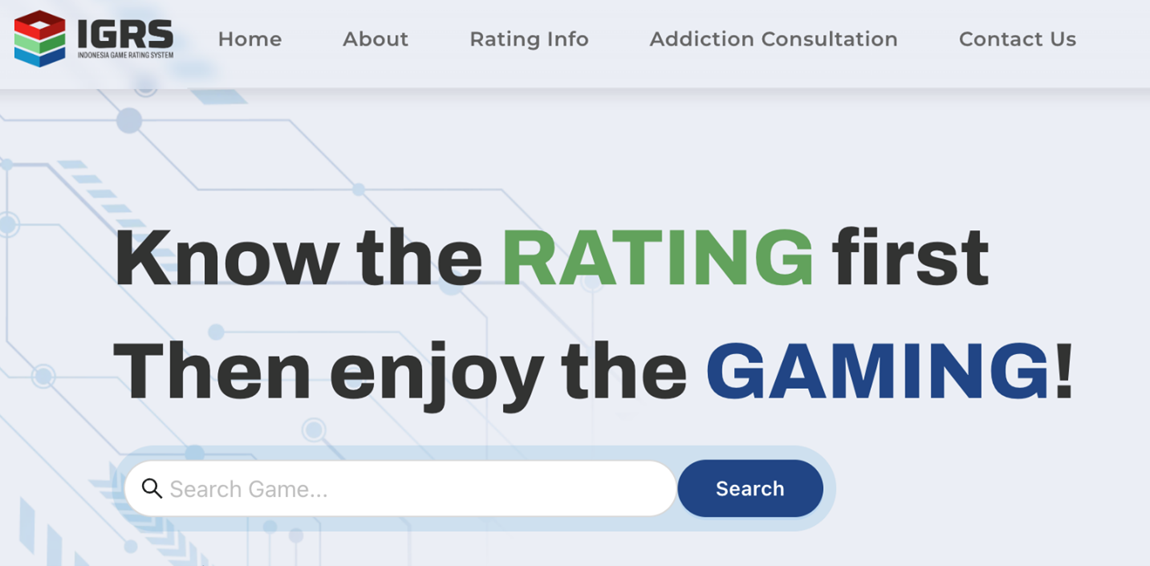
During the first week of April 2026, Indonesian gamers noticed that PC game distribution platform Steam started to show new age ratings for all games. Call of Duty had been issued a 3+ rating despite its violent content, Story of Seasons had received an 18+ rating despite being a farming simulation game, and Grand Theft Auto V had been refused classification altogether. The new labels and ratings are part of the Indonesia Game Rating System (IGRS) introduced by the country’s Ministry of Communication and Digital Affairs (Komdigi, formerly Kominfo).
IGRS is based on Indonesia’s Ministerial Regulation No. 2 of 2024 on Game Classification, a follow up of the Presidential Regulation No. 19 of 2024 on the Acceleration of National Games Industry Development which Niko covered previously. The update to the classification system comes at a time when countries are taking a more hands-on approach towards online content that may be inappropriate or harmful for children. Komdigi has spent the past couple of years working with various game distribution platforms and the International Age Rating Coalition (IARC) to ensure stores such as Steam, the PlayStation Store, and Google Play can adopt the system. In theory, this means that games already registered with IARC should automatically receive an equivalent rating under the IGRS.
IGRS includes 5 main categories (3+, 7+, 13+, 15+, and 18+) as well as the “Refused Classification (RC)” category. While the Indonesian Game Association (AGI) stated that the regulation aims to act as a guideline, not a restriction, it should be noted that the Ministerial Regulation No. 2 of 2024 Article 20 mentions that the ministry can implement an administrative sanction in the form of access denial, which is essentially a rating-based ban. An RC classification would currently result in a game being unavailable for purchase in Indonesia, or as Steam itself puts it, “Steam will no longer be able to display games to customers in Indonesia if the game is missing a valid age rating.” This has the effective function of a ban for games that receive an RC rating for the Indonesian market.
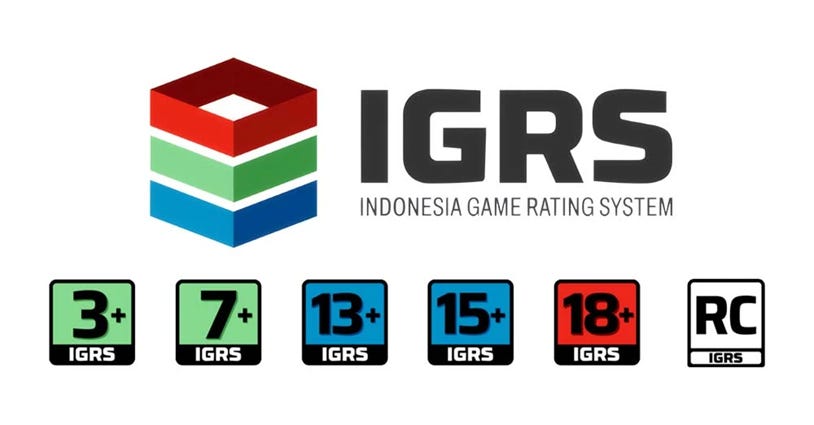
Source: instagram.com/gameratingid
Following confusion from developers and backlash from players after the rating’s implementation on Steam, Komdigi issued a statement clarifying that the IGRS ratings shown on Steam beginning last week were not final, noting that “the ratings circulating on the platform are not official IGRS results, potentially misleading the public regarding age-appropriate content for children.” Following the ministry’s published statement on April 6, Steam also removed the IGRS ratings from its website and platform.
This is not the first time Komdigi has been perceived to backtrack from its policies after receiving negative feedback, as seen in 2022 when the ministry banned game platforms including Steam and Epic Games Store for not following its PSE rule. This decision was also later reversed following protests from local gamers and game industry stakeholders.
Some of the issues may be a matter of methodology- Komdigi has stated that the age ratings were based on a self-classification questionnaire. Niko Partners has reviewed this questionnaire and found that many of the questions are generalized and binary, “yes / no” questions. In one eccentricity, the question asking whether the game depicts “elements of pornography” has “no” as option 1 and “yes” as option 2, while all other questions have the order reversed, which may cause some respondents to accidentally tick yes in this case.
We’ve also seen concerns that the ministry’s Special Staff are confusing user ratings with age ratings, based on the X (formerly Twitter) posts. Both cases showcase how the system’s QA and management process remain a work in progress with developments expected to be forthcoming.
The IGRS labels have since been removed from Steam, with Valve now working with the ministry to cooperate on a more formal approach to implement the system without mass confusion. Roblox also recently announced it has adopted IGRS for its platform, and more platforms are expected to support the system going forward.
According to Niko Partners’ research, nearly 90% of players in Indonesia believe governments should regulate content for children, giving the ministry a mandate to roll out its own platform. Still, while the majority of players Niko surveyed in Indonesia are aware of IGRS ratings, many have concerns that primarily revolve around uneven implementation and uncertainty around whether certain games could be banned.
Indonesia is a large market for video games, with more than $1.1 billion in revenue in 2025 as per Niko’s Indonesia Games Market Report. Steam is a growing platform in the country, but the introduction of a “Refused Classification” category could have a negative impact if the ministry implements it in a way that affects popular titles. We note that these ecosystems are currently fragile, Valve has recently highlighted that Steam’s appeal in markets such as Indonesia is strongly driven by discounts and regional pricing aligned with local purchasing power, so new barriers to access may prove troublesome.
Furthermore, tagging games with the wrong rating could negatively affect the country’s esports industry, with popular esports titles such as Mobile Legends: Bang Bang or League of Legends receiving 18+ rating even though the games are rated as safe for teens in all other country’s rating systems. We will continue to monitor and will include analysis of these policies’ impacts in Niko’s 2026 Indonesia Games Market Report Series.
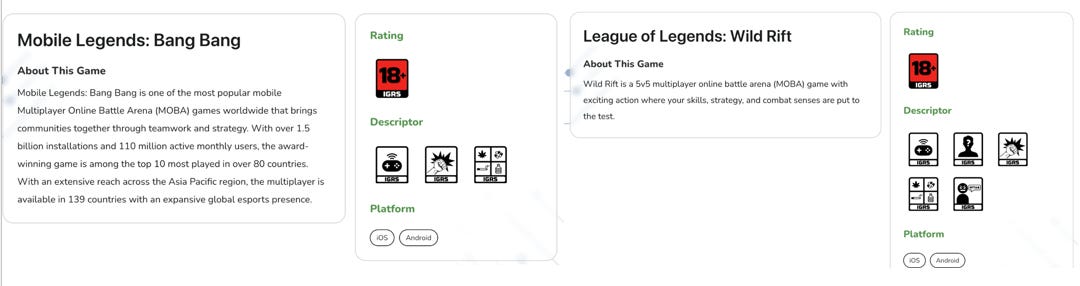
Screenshots from IGRS website showing game ratings of select games
Niko Partners is carefully watching the development of Indonesia’s games market and industry. We expect the country to grow as a games market and in its game development capacity, barring issues created by policy mishaps and assuming clearer communication between the government and game industry stakeholders, both local and international. If your company wants to understand more about game regulations and gamer behavior in Indonesia, please contact us.
Indonesia is the largest game market by population in Southeast Asia. Dive deep into the market through our SEA-6 Games Market Reports and get regular pulse check on the industry through Niko’s Value-Added News Analysis (VANA). We also offer custom research and consulting services designed to address your specific questions and support strategic decision-making.
Author: Darang Candra, Director for Southeast Asia and East Asia Research at Niko Partners