

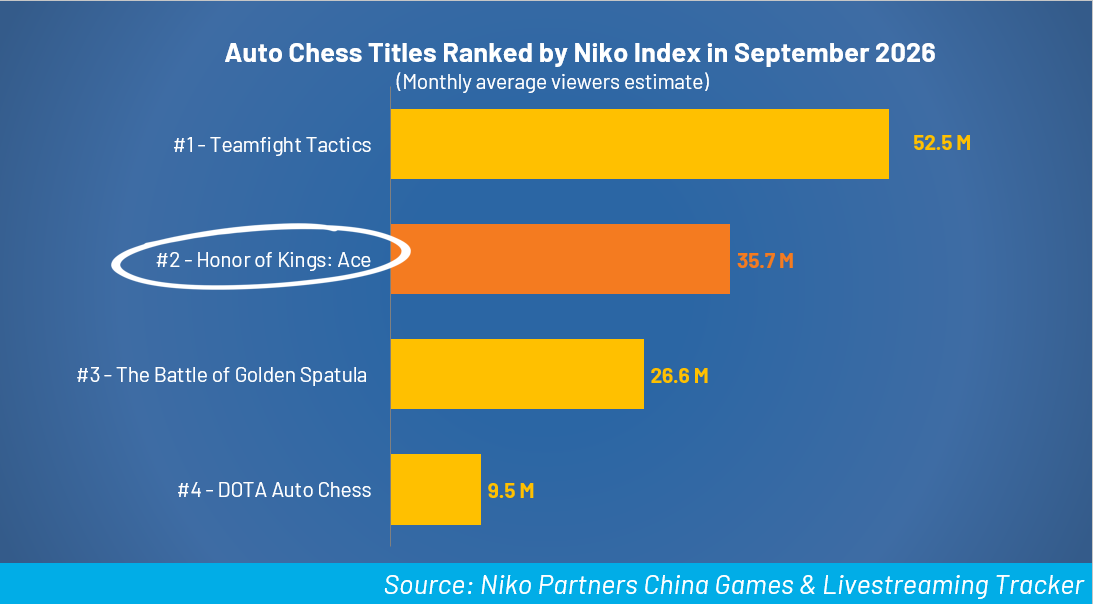
Auto chess ranked among the most-watched genres in China’s livestreaming market in September 2026. Niko Partners China Games & Livestreaming Tracker showed the genre maintained its strong momentum, with the newly launched Honor of Kings: Ace emerging as a key contributor to its continued popularity.
China approves 209 video games in September 2026
The National Press and Publication Administration (NPPA), mainland China’s regulator in charge of game approvals, issued ISBNs for 206 domestic games and 3 import games on September 30, 2026. This is the eighth batch of games approved in 2026 and takes total approvals to 1,524 domestic games and 46 import games. This is the second month in a row where approvals have exceeded the 200 milestone since March 2019. The domestic batch included 185 mobile games, 2 PC games, 1 console game, and 18 cross-platform games, while the import games list included 1 mobile game, 1 PC game, and 1 cross platform game. A total of 15 games were included on the updated ISBN list where publishers can request a name change, publisher change, or additional platform for an existing ISBN.
Why this matters: One of the most notable approvals is miHoYo’s Nodusfall, a new realistic fantasy action RPG developed using Unreal Engine 5 that was first unveiled at Gamescom 2026. Other notable domestic approvals include Archosaur Games’ Lord of Mysteries: The Fool, based on the popular Chinese web novel IP, alongside titles from 4399, YOOZOO, Electronic Soul and other established publishers. Only three imported titles were approved in the September batch. These include Joycity’s Korean basketball title 3on3 FreeStyle, a new game based on the Korean Yulgang IP, and Modern Tanks. Niko Partners projects more than 2,100 licenses will be approved this year including around 75 import games.
Link to original article (Chinese) →
Join us at GamesBeat Next 2026

Meet Niko Partners CEO Lisa Cosmas Hanson at GamesBeat Next 2026 in San Francisco on November 2-3, 2026. GamesBeat Next brings together leaders and decision-makers from gaming, technology, media, and related industries to discuss emerging trends and what lies ahead for interactive entertainment. Register using code LISAHANSON25 for 25% off your ticket.
Manga Productions to publish Persona 4: Revival in MENA region
Saudi based Manga Productions have announced that they will be publishing and distributing SEGA’s upcoming RPG Persona 4: Revival in the Middle East and North Africa, releasing in February 2027. This would be the second time the two publishers collaborate on a major launch for the region, having previously collaborated on the launch of Sonic Racing: CrossWorlds. Much like Sonic Racing, the stated plan is to have a localized marketing campaign.
Why this matters: Manga Productions has also worked closely with a number of game developers, most notably Koei Tecmo, helping them publish and localize Nioh 3, FATAL FRAME II: Crimson Butterfly REMAKE, and Dynasty Warriors: Origins. However, what’s notable about the Sonic Racing and Persona 4 publishing deals is that they do not include Arabic language support. Our research recently found that 37% of players in the GCC would be ok with a game only supporting English text, with an additional 33% supporting an English and Arabic release.
China wins big at 2026 Asian Games esports events
China secured four esports medals, including three golds and one silver, at the 2026 Asian Games in Aichi Nagoya, reinforcing its position as one of Asia’s leading competitive gaming markets. Esports expanded significantly for this edition, with 11 medal events offering 13 gold medals. China sent 23 esports athletes across four events and won a medal in every title it entered. The three gold medals came from Honor of Kings, Naraka: Bladepoint and Identity V, while China took silver in PUBG Mobile. Notably, China did not participate in League of Legends despite winning bronze in the title at the Hangzhou Asian Games in 2023.
Why this matters: Mu Xinyue became the first woman to win an Asian Games esports gold medal in the Identity V final, marking an important milestone for female representation in competitive gaming. China also won Naraka: Bladepoint, another NetEase developed title, and Honor of Kings, Tencent’s flagship MOBA. The results are notable because all four games China entered are either developed by Chinese companies or have major Chinese publishing and esports operations, demonstrating the country’s strength across both game development and competitive performance.
Riot Games establishes subsidiary in Guangzhou to develop strategy game
Riot Games has established a new Chinese subsidiary, Aoquan Guangzhou Network Technology Co., Ltd., with recruitment activity indicating that the company is building a full development team in Guangzhou. Job descriptions provide indications that at least one project could be a mobile city building strategy game, although Riot has not officially announced the project. The Guangzhou expansion is notable because Riot’s development footprint in China has previously been concentrated in Shanghai.
Why this matters: Its Shanghai development center opened in 2021 as Riot’s first major development center outside its Los Angeles headquarters and has grown to approximately 300 employees, with plans to reach around 500. The team is working on a new League of Legends IP action RPG, among other development initiatives. Guangzhou could provide Riot with access to a different talent pool that can build titles beyond what Riot Games is traditionally known for.
Link to original article (Chinese) →
China’s Generative AI userbase reaches 700 million
The number of generative AI users in China exceeded 700 million as of June 2026, according to a report from the China Internet Network Information Center, highlighting the rapid mainstream adoption of consumer AI services. This represents an increase of at least 98 million users from 602 million at the end of 2025, or growth of more than 16% in six months. General information retrieval remains the dominant use case, with approximately 76% of users primarily using AI for question and answer interactions.
Why this matters: The number of users engaging with AI assistants and AI productivity tools for office work increased by more than 100% YoY, suggesting that generative AI is increasingly being integrated into everyday workflows rather than used primarily for experimentation. Niko Partners data shows that approximately 70% of players in China are interested in GenAI being integrated into video games, with 29.5% of players already using AI tools to search for game information.
AI only delivers publicly available data. Don’t build your video game strategy without diving deeper.
Marvel Rivals faces criticism over poor reporting and moderation systems
NetEase’s Marvel Rivals is facing criticism from Western players and content creators following changes to its in-game reporting system that removed hate speech as a dedicated reporting category. Players attempting to report racism, sexism, homophobia and other discriminatory behavior in text or voice chat have found that there is no longer a specific option covering such conduct. The change has attracted particular attention because some players and creators had already raised concerns about how effectively Marvel Rivals moderates abusive communication.
Why this matters: The backlash demonstrates how trust and safety systems have become an important component of live service operations, particularly for competitive multiplayer games. While the removal does not necessarily mean NetEase has stopped taking action against hate speech, as inappropriate behavior may still fall under broader reporting categories or moderation policies, it does raise concerns and creates uncertainty for players in regard to how discriminatory behavior should be reported and whether such reports will be prioritized appropriately.
Krafton cancels another PUBG spin-off game as it tries to find new direction for the IP
Krafton has ended development of PUBG: Black Budget, approximately nine months after the extraction shooter entered closed alpha testing on Steam. The project underwent several alpha and community tests during 2026, but will no longer proceed toward commercial release. Its cancellation marks the second PUBG spin-off discontinued this year, following Krafton’s March closure of free to play tactical shooter PUBG: Blindspot, just two months after it entered Early Access.
Why this matters: Both projects formed part of Krafton’s broader effort to expand PUBG beyond battle royale and test the IP across new genres. The company has also outlined plans to evolve PUBG: Battlegrounds into a broader content platform, including sandbox oriented UGC built around its existing gunplay, mechanics and physics. Despite the cancellations, experimentation with the franchise is continuing. Krafton unveiled PUBG: Ded.Net at Gamescom in August, a multiplayer shooter incorporating roguelike progression.
China elevates video games in 5-year plan for publishing industry
In March 2026, China’s Five Year Plan for 2026 to 2030 identified online games alongside web literature, film, television and animation as important components of China’s cultural export strategy. This direction was reinforced on September 21, when the National Press and Publication Administration issued its 15th Five Year Plan for the publishing industry, systematically incorporating online games into a national publishing industry plan for the first time. While existing regulatory controls still remain in place, greater emphasis on licensing stability, technology development and exports provides a more supportive policy environment for Chinese publishers seeking to build globally competitive game IP.
Why this matters: The plan calls for strengthening the supply of ISBNs while optimizing online publishing service licenses. Games are also being incorporated into China’s broader push for high quality popular cultural works. The plan also calls for an AI empowered publishing initiative, support for technology innovation laboratories and participation by online publishing companies in national technology programs. International expansion is explicitly encouraged, with the plan calling on online games to deepen their presence in global markets. The policy further institutionalizes a shift in China’s treatment of games from primarily a regulated entertainment product toward a strategically supported cultural and technology industry.
Link to original article (Chinese) →
Nexon expands ARC Raiders and The Finals into film and television
Nexon has partnered with Chernin Entertainment to develop film and television adaptations of ARC Raiders and The Finals, extending two of Embark Studios’ game franchises into broader entertainment IP. The move follows the breakout performance of ARC Raiders, which launched in October 2025 and has since sold more than 16 million copies worldwide. The Finals provides a second established franchise for the partnership, which has registered more than 30 million players since launch. Its fictional televised competition format also provides a narrative framework that could translate relatively naturally into other entertainment formats.
Why this matters: The partnership reflects a broader transmedia push across the games industry, as publishers increasingly view successful games as entertainment franchises that can extend into film, television, animation and other media. Recent adaptations such as Fallout, The Last of Us and Cyberpunk: Edgerunners have demonstrated that screen adaptations can both monetize IP independently and drive renewed awareness and engagement for the underlying games. Publishers are consequently considering transmedia potential earlier in an IP’s lifecycle rather than waiting for franchises to mature over decades.
Wemade employees establish union ahead of ownership change
Employees of Wemade established a labor union under the Korean Confederation of Trade Unions’ Chemical Fiber Food Workers’ Union as the game company moves toward a change in control involving Neopulse and Chinese game company Kingnet. The union plans to oppose potential restructuring and layoffs associated with changes in major shareholders or organizational restructuring, unilateral changes to working conditions, and changes to incentive payment systems, while seeking prior consultation on major business decisions and employment continuity for key operations including WEMIX.
Why this matters: Park Kwan Ho agreed on June 30 to sell his entire 39.33% stake in Wemade to Neopulse for KRW 920 billion ($657 million), and an investor consortium involving Neopulse and Kingnet is expected to hold 40.25% and become the largest shareholder if the transaction closes as planned by October 30. Wemade said it would respect the union’s rights, comply with relevant laws and procedures, and pursue labor relations based on mutual respect and open dialogue.
Chinese flagship smartphones see sharp price increases
China’s leading smartphone manufacturers are raising flagship handset prices as rising memory costs continue to put pressure on consumer electronics manufacturers. Vivo, Oppo, Xiaomi and Honor all introduced new flagship devices in September 2026 with standard versions increasing in price by approximately RMB 500 ($70) to RMB 1,100 ($155) compared with their predecessors. Price increases are substantially larger for higher storage configurations, reaching as much as RMB 3,000 ($422).
Why this matters: The latest generation of mainstream Chinese flagship smartphones now generally starts at approximately RMB 5,500 ($774), while comparable storage configurations can cost more than RMB 1,000 above the previous generation. This reflects how higher memory costs disproportionately affect devices with larger RAM and storage configurations. At the same time, manufacturers are increasingly using AI functionality to justify premium positioning.
Events
LEVEL UP KL
October 14-16, 2026
Kuala Lumpur, Malaysia
Speaker: Darang Candra
Attendee: Edward Tien
GamingCon Bharat
October 17-18, 2026
Mumbai, India
Speaker: Narinder Kapur
gamescom asia x Thailand Game Show
October 29 - November 1, 2026
Bangkok, Thailand
Attendees: Niko Partners Senior Leadership Team
Montréal International Game Summit (MIGS)
November 10-11, 2026
Montreal, Canada
Speaker: Alexander Champlin