

The MENA gaming market continues to demonstrate resilience and long-term potential. Despite ongoing geopolitical uncertainty, Egypt, Saudi Arabia, and the UAE (MENA-3) remain among the fastest-growing gaming markets tracked by Niko Partners, supported by strong government initiatives, rising disposable incomes, improving localization efforts, and growing participation from female gamers.
MENA Is One of Gaming’s Most Promising Growth Regions
MENA-3 continues to benefit from favorable market dynamics that are accelerating gaming adoption across the region. Government support for gaming and esports remains robust, while publishers are increasingly investing in localized content to better serve local audiences.
A key growth driver is the expanding and increasingly diverse player base. Female participation in gaming continues to rise, and consumer spending is steadily shifting toward entertainment and digital experiences. While geopolitical instability may create short-term challenges, long-term growth is expected to be driven by:
Increased game localization and culturally relevant content
More open and flexible game approval processes
Rising average revenue per paying user (ARPPU)
Growing disposable incomes across key markets
These factors position MENA-3 as a critical growth opportunity for publishers seeking expansion beyond more mature gaming markets.
Revenue Growth and Player Spending Continue to Climb
MENA-3 is projected to remain the second fastest-growing region tracked by Niko Partners, trailing only India. The region generated $2.15 billion in gaming revenue in 2025, representing 7.1% year-over-year growth. Niko Partners forecasts revenue to grow 7.8% in 2026 to $2.31 billion, reaching $2.94 billion by 2030, reflecting a five-year CAGR of 6.5%.
Just as notable is the region’s spending potential. MENA-3 is expected to record the strongest ARPU growth among all regions in Niko’s forecast. Annual ARPU is projected to reach $38 by 2030, nearly $10 higher than 2025 levels, while the UAE is set to surpass $100 ARPU this year.
As monetization improves and disposable incomes increase, player spending is expected to become an even more important driver of market growth over the remainder of the decade.
Understanding MENA Players: Localization, Spending, and Esports
For international publishers, localization remains one of the most important factors for success in MENA. According to Niko Partners’ 2026 survey, respecting religious values ranks as the second most important localization consideration when players evaluate new games. This underscores the importance of cultural understanding and regional relevance when bringing global IP to MENA audiences.
The survey also revealed a notable shift in spending behavior. Both high-spending players and non-spenders increased year-over-year, highlighting a growing polarization in player spending. Future revenue growth may depend less on converting every player into a payer and more on effectively retaining, monetizing, and expanding spending among high-value player segments.
Meanwhile, Saudi Arabia continues to strengthen its position as a global gaming and esports hub under Vision 2030. Investments from government entities, Public Investment Fund-backed companies, and private organizations are accelerating the development of local talent, infrastructure, game studios, and esports initiatives. Major events such as the Esports World Cup and the upcoming Esports Nations Cup are helping bring competitive gaming further into the mainstream while reinforcing Saudi Arabia’s growing influence on the global esports stage.
Market Regulatory Changes Are Reshaping the Market
Recent regulatory developments across MENA have increasingly focused on online child safety, creating varied approaches across different countries. Egypt has implemented a full ban on Roblox, while Saudi Arabia and the UAE introduced temporary restrictions aimed at enabling stronger moderation and safety measures.
At the same time, Saudi Arabia’s introduction of a 21+ age rating provides regulators with greater flexibility when evaluating mature titles. Games that previously faced significant restrictions, including titles such as Grand Theft Auto, can now receive approval with minimal or no modifications, creating new opportunities for publishers targeting adult audiences.

Some of the key takeaways from the report:
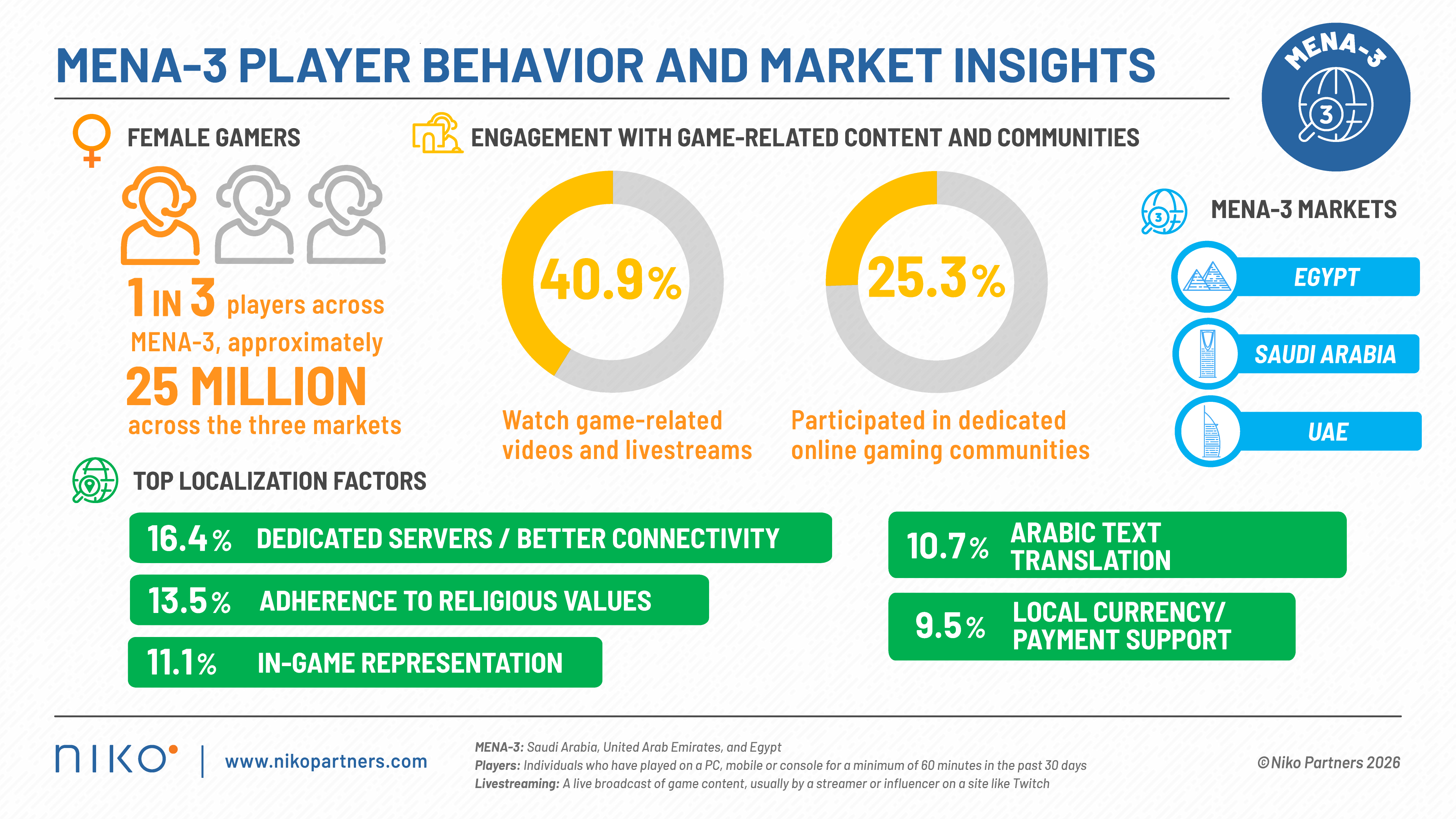
About 40.9% of respondents across MENA-3 regularly tune in to video game-related content, including livestreams and gaming videos, whereas one in four gamers (25.3%) actively participates in dedicated online gaming communities, reinforcing the importance of social interaction and community-driven experiences.
The region’s gaming audience is also becoming increasingly diverse. More than one-third of players are female, representing over 25 million gamers across the three markets.
When it comes to localization, players are looking for more than just language support. Dedicated servers (16.4%) rank as the most important localization factor, followed by alignment with religious values (13.5%), in-game representation (11.1%), text translation (10.7%), and local currency and payment options (9.5%).
Fill out this form here to download more select key takeaways from the report
As gaming audiences mature and spending power grows, success in MENA will increasingly depend on understanding local preferences, investing in meaningful localization, and building long-term engagement strategies tailored to the region’s unique cultural and economic landscape.
At Niko Partners, we help businesses turn market intelligence into action. Through our syndicated research, subscription-based insights, and custom consulting services, we provide the data, analysis, and strategic guidance needed to navigate the rapidly evolving gaming markets across Asia and MENA. Whether you are evaluating market expansion opportunities, analyzing player behavior, assessing monetization strategies, or tracking regulatory developments, our research helps organizations make informed business decisions with confidence. Contact us to learn how Niko Partners can help your organization identify growth opportunities and build successful strategies in one of the world’s largest and most dynamic gaming markets.