

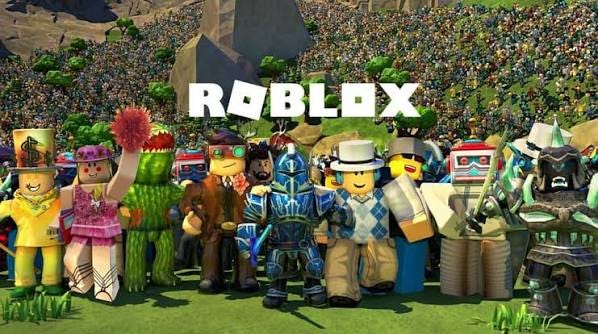
Roblox corp has launched Roblox Arabia, a new set of Arabic language social media channels designed to provide localized content, news, and platform updates for users across the Arab world. The channels will also promote regional creators, experiences, and communities, giving Roblox a dedicated communications presence for Arabic speaking users. The launch is the latest step in Roblox‘s broader MENA expansion. In May 2026, the company signed an MoU with Saudi Arabia’s Savvy Games Group focused on developing the Kingdom’s game development ecosystem. Roblox subsequently announced plans to establish its MENA regional headquarters in Riyadh, with the office expected to support regional creators and strengthen relationships with local stakeholders.
Why this matters: For Roblox, localization is also becoming increasingly important from a regulatory perspective. Roblox has been expanding its Arabic language moderation and safety capabilities following scrutiny from MENA regulators over content accessible to younger users. The combination of localized moderation, regional operations, government and industry partnerships, and Arabic communications should help Roblox demonstrate greater responsiveness to local regulatory and cultural requirements. This is particularly important for a user generated content platform with a substantial younger audience, where inadequate moderation can increase regulatory risk.
Japanese gaming IP has a strong foothold in Qatar
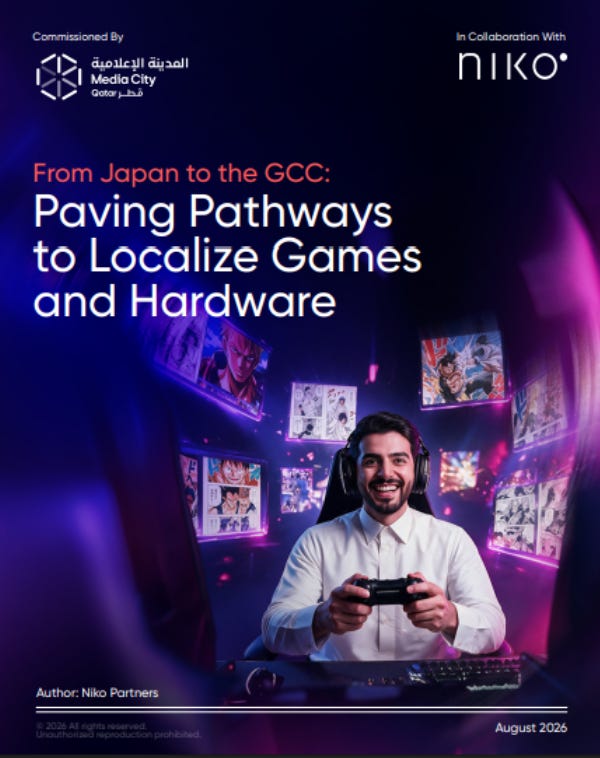
Japanese gaming culture is making a strong impression on players in Qatar, one of key market in the The Gulf Cooperation Council (GCC) region. Our latest research found that 95% of surveyed players in the country could name at least one Japanese video game franchise, with almost half recognizing five or more.This demonstates Japanese gaming IP already has remarkable visibility in the market, creating opportunities for publishers, brands, and investors to build deeper connections with local audiences. Discover what this means for the GCC gaming landscape in our latest research brief, commissioned by Media City Qatar in collaboration with Niko Partners.
Download the research brief here →
Leading Chinese game companies report positive earnings in H1 2026, with diverging areas of growth
Financial results from 24 major listed Chinese game companies highlight an increasingly divergent market in H1 2026, with 17 companies profitable and 7 reporting losses. While China’s largest publishers continue to benefit from diversified portfolios and established evergreen titles, results among smaller companies remain significantly more dependent on individual game performance. Tencent reported 9.7% YoY growth in online games growth, while NetEase reported 8.3% YoY growth. Century Huatong recorded particularly strong growth, up 28.5% YoY. At the same time, Perfect World reported its first H1 loss in nearly a decade as a result of weakening revenue from older titles during a transition period ahead of new releases.
Why this matters: While Tencent and NetEase continue to see balanced growth across both domestic and international markets, Century Huatong’s growth has been more heavily driven by overseas markets. Century Games, its international publishing subsidiary, has benefited from the sustained performance of Whiteout Survival and Kingshot which have emerged as top grossing strategy games overseas. H1 2026 demonstrates that China’s games market is growing, but with diverging outcomes for mid sized publishers who not only have to compete with Tencent and NetEase at home, but also leading global game companies overseas.
Link to original article (Chinese) →
Why the mini game market matters in China
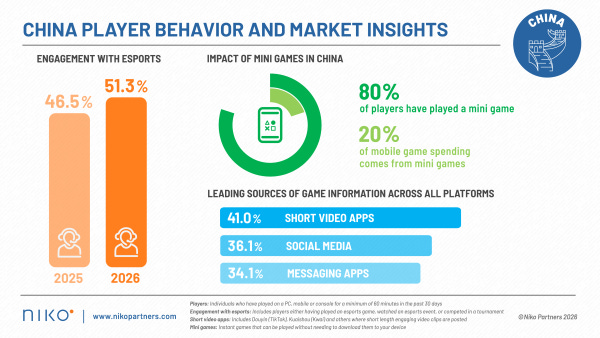
Mini games are emerging as a major growth engine in China’s mobile gaming market, it is now a segment worth watching closely. About 80% of Chinese players engage with mini games, which now account for nearly 20% of mobile game spending. Learn more about our findings in our recently released China Player Behavior & Market Insights report here.
Download the key takeaways here →
China approves 215 video games in July 2026
The National Press and Publication Administration (NPPA), mainland China’s regulator in charge of game approvals, issued ISBNs for 209 domestic games and 6 import games on August 31, 2026. This is the seventh batch of games approved in 2026 and takes total approvals to 1,318 domestic games and 43 import games. This is also the first time that monthly approvals have exceeded 200 since March 2019. Although we note that import game approvals are down from 68 at this point last year. The domestic batch included 188 mobile games, 1 PC game and 20 cross-platform games, while the import games list included 4 mobile games and 1 cross platform games. New games from 37 Interactive, Shengqu, Sunborn, Changyou, Duoyi, Ourpalm, Yoozoo and Archosaur Games among others were approved. A total of 12 games were included on the updated ISBN list where publishers can request a name change, publisher change, or additional platform for an existing ISBN.
Notable domestic titles approved include Dragon Nest Classic (Shengqu), A Mortal’s Journey to Immortality (37 Interactive), and Tap Breakout (Sunborn), a spin-off in the Girls Frontline franchise. Notable import games include Solo Leveling: Arise (Netmarble), CookieRun: Tower of Adventures (Devsisters), Loop Hero (Devolver Digital), and Seal Online (Playwith). We expect over 2,000 domestic and import games to be approved this year.
Games industry employment shifts towards APAC and China
Games industry employment is undergoing a significant geographic redistribution despite continued layoffs, according to data presented by Amir Satvat, general partner at 1Up Ventures and former Tencent executive, during the opening keynote at Gamescom Dev 2026. Satvat projects 14,666 games industry layoffs in 2026, approaching the 2024 peak of 15,631. Approximately 10,140 layoffs had already been announced by August 11, exceeding the 9,200 recorded across all of 2025. However, total global games industry employment has remained relatively stable, suggesting that job losses are increasingly being offset by hiring elsewhere.
Why this matters: The clearest shift is away from North America. Satvat estimates the region accounted for more than two thirds of tracked layoffs, losing approximately 25,000 roles, equivalent to 15% of its games workforce, over the broader period analyzed. California has been particularly affected, accounting for more than half of global layoffs during one 12 to 18 month period. Satvat attributed the geographic shift to factors including labor costs, government incentives, and talent availability. By comparison, available games industry roles increased 10% across APAC, including 12% growth in China, while Europe remained broadly flat.
Chinese smartphones see another round of price increases
China’s smartphone market is facing another wave of price increases as Huawei, Xiaomi, and Honor raised retail prices for selected existing models by RMB 200 ($30) to RMB 1,000 ($149). The increases reflect continued pressure from memory shortages and rising semiconductor costs rather than the typical premium attached to new product launches. TrendForce estimates that memory prices have increased five to sevenfold since the beginning of 2025. Smartphone vendors are also expected to streamline their portfolios, with some higher specification models potentially delayed or cancelled.
Why this matters: We’re also seeing cost inflation broadening beyond memory with Qualcomm CEO Cristiano Amon saying in July that the company planned to increase product prices from September 1, adding further pressure to bill of materials costs for manufacturers dependent on its mobile chipsets. China’s smartphone shipments are forecast to decline by double digits YoY in 2026, meaning manufacturers must manage higher production costs while consumers simultaneously face higher device prices and weaker purchasing incentives. The impact is increasingly being felt across all of consumer electronics raising the likelihood of higher prices, reduced specifications, delayed products, and weaker upgrade cycles.
Link to original article (English) →
There’s nothing artificial about our consumer insights and business intelligence.
Honor of Kings: Ace reaches 70M pre-registrations ahead of launch
Tencent will launch Honor of Kings: Ace, a strategy hero card battler based on the Honor of Kings IP, in China on September 10, 2026. The title has accumulated more than 70 million pre-registrations, providing Tencent with a substantial initial audience ahead of release. The project was first announced in 2022 as an auto chess style spinoff following the popularity of Dota Auto Chess, which helped establish the genre. It adapts familiar Honor of Kings heroes and characters into a more strategic format centered on team composition and card based mechanics. The game has undergone several years of development and multiple closed beta tests, including its most recent test in June 2026.
Why this matters: The title forms part of the company’s broader effort to expand Honor of Kings from a single evergreen MOBA into a multiplatform franchise spanning multiple genres. Tencent recently pursued a similar strategy with Honor of Kings World, an open world RPG spinoff. While the title has achieved moderate commercial success, it has not displaced China’s leading RPGs, demonstrating the challenge of translating the enormous popularity of Honor of Kings into comparable success across different genres. However, we note that Ace has seen significant pre-launch interest via our China Games & Livestreaming Tracker which shows high viewership of previous closed beta footage and the games release date announcement stream.
Successful Onimusha launch reinforces Capcom strategy to revive dormant IP
Capcom plans to increase its focus on reactivating dormant IP following the strong launch of Onimusha: Way of the Sword, the franchise’s first mainline installment in more than two decades. Onimusha: Way of the Sword sold more than 1 million units worldwide on its September 4, 2026 launch day, taking lifetime sales for the Onimusha franchise above 10 million units since its debut in 2001. Capcom said prerelease demos and hands on showcases contributed to awareness among both existing fans and newer players. The performance provides further validation for Capcom’s strategy of extracting additional value from its extensive IP catalog.
Why this matters: Alongside annual releases for major franchises, the company said it intends to revive properties that have not received new titles recently, potentially allowing it to diversify its portfolio without relying exclusively on its largest franchises such as Resident Evil, Monster Hunter, and Street Fighter. However, Capcom is not limiting investment to established brands. Pragmata, a rare new IP from the company, launched in August and surpassed 1 million units within its first few days, demonstrating that Capcom continues to invest in original properties alongside franchise revivals.
Dubai to expand partnership with Xsolla for new accelerator program
The Dubai Films and Games Commission has expanded its partnership with Xsolla through a new games accelerator program launching in October 2026, as the emirate continues to build infrastructure aimed at attracting and developing game companies. Announced during Gamescom 2026, the initiative will establish Dubai as home to only the second permanent Xsolla Club globally. The hub will give local, regional, and international developers direct access to Xsolla’s accelerator team and wider network, providing support across areas such as funding, commercialization, distribution, and market expansion.
Why this matters: The initiative builds on a partnership that began with an MoU in 2025 and has subsequently expanded into networking events, market research, and developer support. It also forms part of the broader Dubai Program for Gaming 2033, which aims to position Dubai among the world’s top 10 gaming hubs. According to the Dubai Films and Games Commission, Dubai now hosts 495 gaming companies, up 34.5% over the past two years. The emirate is targeting approximately 30,000 games industry jobs and nearly $1 billion in additional GDP contribution by 2033.
Cygames announces new gaming brand, CygamesEdge
Japanese developer and publisher Cygames, best known for Umamusume: Pretty Derby and Granblue Fantasy, has established a new brand called CygamesEdge focused on supporting small and medium-sized development teams while leveraging Cygames’ existing development and publishing expertise. Its first announced project is Where the Seeds Fall, which is being co-developed with Japanese studio Zereo and will launch for PS5, Switch 2, and Steam on November 5, 2026. The multiplatform approach also reflects the continued shift among Japanese publishers toward simultaneous releases beyond individual console ecosystems.
Why this matters: CygamesEdge forms part of a broader strategy to pursue smaller projects that can be developed and released more frequently over shorter production cycles. Cygames has highlighted rising development costs and quality expectations as an industry challenge, with larger publishers committing increasing amounts of capital to individual games. Rather than concentrating its portfolio entirely around increasingly expensive projects, Cygames can use smaller teams and more compact development cycles to diversify its release slate, experiment with new concepts, and reduce the financial exposure attached to individual titles.
Events
Tokyo Game Show
September 17-18, 2026
Tokyo, Japan
Attendee: Darang Candra
LA Games Conference
September 30, 2026
Los Angeles, USA
Speaker: Lisa Hanson
Attendee: Alexander Champlin
Use code NikoPartners20 for 20% off
GamingCon Bharat
October 17-18, 2026
Mumbai, India
Attendee: Narinder Kapur