


The Super Mario Galaxy Movie has become the first film of 2026 to surpass $1 billion at the global box office, according to Box Office Mojo. Produced by Universal Pictures and Illumination in partnership with Nintendo, the animated sequel expands the company’s rapidly growing entertainment strategy around its gaming IP portfolio. The film is based on the Super Mario universe, with particular inspiration drawn from the Galaxy series of games, which originally launched on the GameCube and later received a Nintendo Switch remaster in 2025. The achievement is particularly notable given the film’s mixed reception among critics given it currently holds a 42% score on Rotten Tomatoes.
Why this matters: This is Nintendo’s second movie to reach the $1 billion milestone following the success of The Super Mario Bros. Movie, which generated approximately $1.36 billion worldwide following its release in 2023. With a reported production budget of approximately $110 million, the movie has already generated revenue many times greater than its development and marketing costs. This continues Nintendo’s recent success in extending its franchises beyond games into film, theme parks, merchandise, and other entertainment categories. However, we note that non-console platform revenue continues to account for around 5% of Nintendo’s earnings, highlighting the high reliance on its traditional business.
Livestreaming Tracker May 2026 Highlights: New Releases and Major Updates Diversify China’s RPG Viewership Landscape
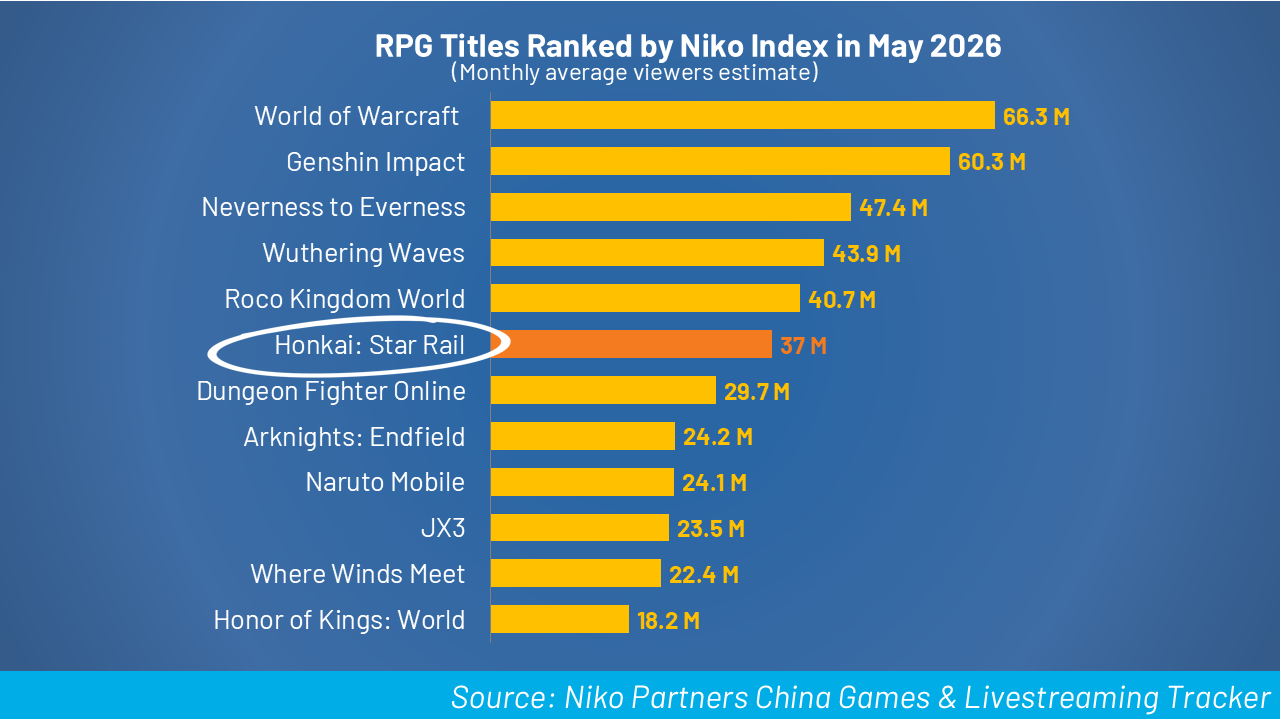
RPG titles led China’s livestreaming charts in May 2026, while Chaos Zero Nightmare quickly gained traction and secured a notable share of RPG viewership. Read the key highlights from Niko’s China Games & Livestreaming Tracker here.
Saudi eLeague 2026 highlights women’s esports growth in Saudi Arabia
The Yalla Saudi eLeague Women 2026 was held from February 23 to June 6, featuring online preliminary rounds and live finals at the Saudi Esports Federation Arena in Riyadh, highlighting the growing competitiveness and talent among female gamers in the region. Saudi female players competed in a competitive environment across Overwatch 2, Valorant, EA FC26, and Call of Duty: Black Ops 7. Yalla Group joined as the official partner of the Saudi eLeagues this year and operated interactive booths showcasing Yalla Ludo, Jalsat, and Turbo Match.
Why this matters: The Championship Festival Finals, held from May 1 to June 6, gathered players, fans, creators, and industry stakeholders at SEF Arena in Riyadh, representing one of the region’s largest esports gatherings. Saudi eLeague, organized by the Saudi Esports Federation and established in 2020, continues to support Vision 2030 through structured competitions designed to expand the Kingdom’s esports landscape, with the Women’s eLeague reinforcing its commitment to supporting esports growth and diversity in Saudi Arabia and the wider MENA region. Women gamers continue to be on the rise in Asia & MENA (read our latest Knowledge Brief about this).
Asian Champions League generates 380 million views
Hero Esports announced that the 2026 Asian Champions League (ACL) generated more than 380 million total play views across its three featured titles: Dota 2, Counter-Strike 2, and Mobile Legends: Bang Bang. The second edition of the tournament took place in Shanghai from May 1 to May 24, combining eight days of offline competition with 18 days of online broadcasts. Matches were hosted at venues in Yangpu and Minhang districts and distributed across China’s major streaming platforms including Bilibili, Douyin, DouYu, Huya, and Kuaishou.
Why this matters: The ACL demonstrates the continued maturation of Asia’s esports ecosystem beyond individual game publishers and leagues. Beyond competition, Hero Esports emphasized the commercial ecosystem surrounding the event. The event incorporated hospitality services, tourism support, retail activations, and player appearances as part of a broader effort to integrate esports with local commerce and entertainment. The event also highlights Shanghai’s growing role as a global esports destination. The event was also broadcast in multiple languages, reflecting Hero Esports’ ambition to position ACL as a pan Asian esports property.
Tencent launches AI powered interactive storytelling platform
Tencent Games has launched Zaohua Workshop, an AI powered interactive storytelling platform developed by its Lightning studio. The platform is positioned as a one stop creation and distribution ecosystem for AI generated interactive narrative experiences, allowing users to both create and play full motion video games. The platform significantly lowers the barriers to content creation by enabling users to generate interactive narrative experiences through natural language prompts without requiring programming, game design, or development expertise.
Why this matters: Zaohua Workshop currently supports a broad range of genres and content can be generated across multiple visual styles. At launch, nearly 60 AI generated interactive experiences were available across categories such as mystery, fantasy adventure, urban romance, wuxia, and science fiction. Early demonstrations suggest the platform can produce interactive video based experiences and lightweight gameplay with minimal creator input. The initiative represents Tencent’s latest effort to apply generative AI directly to consumer facing content creation.
Slay the Spire 2 shows split between Chinese and Western players
Slay the Spire 2 has continued to face significant review pressure from Chinese players despite achieving strong commercial success in the market. China has emerged as the game’s largest market, with sales exceeding 2 million copies according to our estimate, yet only 28% of Chinese language Steam reviews are positive compared to 86% of English language reviews. Recent analysis from leading Chinese community figures has provided additional context behind the backlash. While balance concerns have been widely discussed previously, one notable issue involves differing gameplay habits between Chinese and Western audiences.
Why this matters: Chinese players often approach optimization, progression efficiency, and mastery systems differently, resulting in gameplay expectations that may not align with developer intentions or overseas player preferences. More importantly, the situation highlights structural communication challenges within China’s gaming ecosystem. Unlike Western communities that rely heavily on Discord, Reddit, and other direct developer communication channels, Chinese players have fewer avenues to engage directly with overseas developers. As a result, Steam reviews frequently function as a primary feedback mechanism rather than solely a purchasing recommendation tool.
AI-driven memory shortages lead to increased prices for smartphones in China
Rising memory costs driven by surging AI infrastructure demand are beginning to materially impact China’s smartphone market, with manufacturers increasing prices across a wide range of mid range devices that have traditionally been the industry’s most competitive segment. Recent launches including the Honor 600, Oppo Reno16, Vivo S60, and Huawei Nova 16 have generally been priced between RMB 300 ($44) and RMB 1,000 ($148) higher than their predecessors. According to TrendForce, LPDDR5X DRAM prices are expected to increase between 78% and 83% quarter over quarter, while LPDDR4X prices are forecast to rise between 70% and 75%.
Why this matters: These components are critical to smartphone production, making memory one of the largest contributors to recent cost inflation across the industry. Companies such as Oppo and Huawei are attempting to justify higher prices through improved camera systems, larger batteries, and the introduction of flagship features into mid range devices. Meanwhile, Vivo and Honor have introduced lower specification “vitality” variants to maintain lower entry price points while increasing prices on standard models. For mobile gamers, higher prices and longer upgrade cycles will mean players continue to be tied to existing GPU specs for the foreseeable future.
DeepSeek in talks to raise $7 billion from investors including gaming companies
DeepSeek is reportedly preparing its first external fundraising round, seeking approximately RMB 50 billion ($7 billion) in new capital. According to Reuters, the round would value the company at between RMB 350 billion and RMB 400 billion ($49 billion to $56 billion) post investment, making it one of the most valuable AI startups in China. Among external investors, Tencent is expected to invest RMB 10 billion ($1.5 billion), while CATL is reportedly committing RMB 5 billion ($740 million). Additional discussions are said to be underway with China’s National AI Industry Investment Fund, NetEase, and JD.com. Fewer than 10 investors are expected to participate.
Why this matters: The scale of the proposed financing reflects the growing strategic importance of AI within China’s technology sector. Since emerging as one of China’s leading large language model developers, DeepSeek has become a prominent domestic alternative in a market increasingly focused on technological self sufficiency and reduced dependence on foreign AI infrastructure. Both Tencent and NetEase have been rapidly increasing investment in AI across development pipelines, content generation, NPC systems, UGC creation tools, and live service operations, with Tencent previously announcing a partnership with DeepSeek for smart NPCs in Peacekeeper Elite.
Arc Raiders to get enhanced PVE mode in China version
Arc Raiders, developed by Embark Studios and backed by Nexon was originally released in October 2025 and has already sold more than 16 million units in less than a year. The game has already received a license to launch in China, published by Tencent, and is already undergoing testing. Tencent and Embark have created a specific PVE mode in the China version of the game where friendly fire is disabled by default and players have to work together to secure objectives. Meanwhile, another mode adds either a King or Queen to the map alongside a Matriarch, unleashing mayhem that indirectly incentivizes players to work together against the chaos.
Why this matters: While the Chinese player base on the international version remains limited, they have been vocal about the shift away from PvE in the game. While players generally accepted PvP as a core part of the extraction shooter genre, feedback circulating within Chinese communities suggested some players perceived the balance between PvE and PvP as changing in ways that undermine the game’s original appeal. It’s clear that the developers are listening to early feedback and using that to shape the experience for the official China launch.