

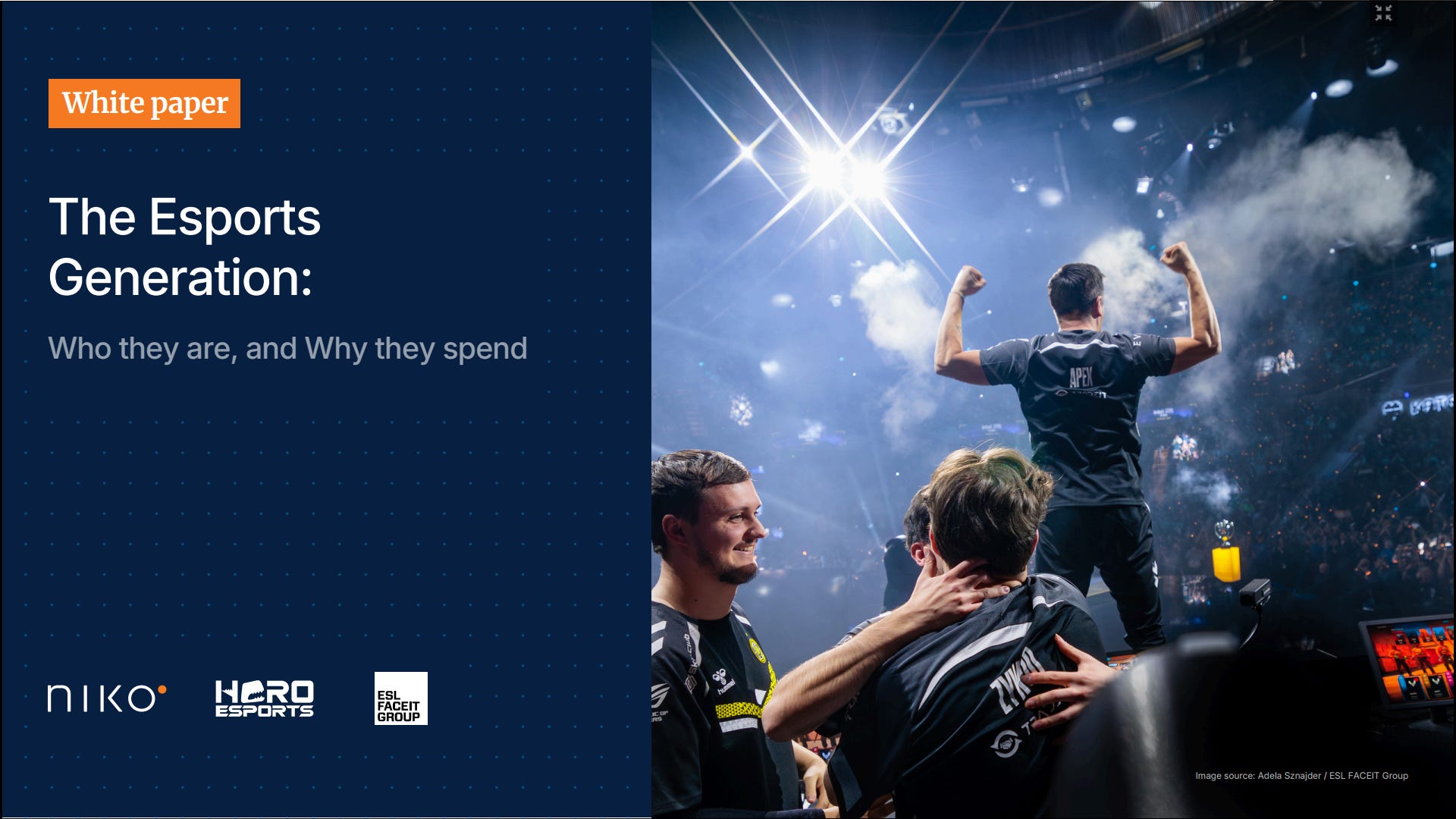
Esports has become a major global entertainment platform for Gen Z, offering the same sense of passion, identity, and community found in other sports. To better understand this audience, Niko Partners surveyed 8,000 Gen Z esports fans and estimated that the global Gen Z esports audience now exceeds 400 million people. Produced in collaboration with Hero Esports and ESL FACEIT Group, this free whitepaper explores what drives Gen Z esports fans, how they engage with brands, and what fuels their loyalty. Discover key insights for brands looking to connect with one of the world’s most engaged audiences.
Asian Games 2026 esports competition schedule finalized
The Japan esports Association (JESU) has finalized match dates and times for all esports events at the Asian Games 2026 (Aichi-Nagoya), where esports will be contested as part of the official medal program featuring national team competition. The esports events will take place from September 23 to October 2 at Exhibition Hall D of Aichi Sky Expo and include competitions for: Gran Turismo 7, eFootball, Naraka: Bladepoint, Puyo Puyo eSports, Pokemon Unite, Honor of Kings, PUBG Mobile, Identity V, Mobile Legends: Bang Bang, and League of Legends.
Why this matters: Esports has earned a solid position at the Asian Games following its initial inclusion as a demonstration event in Jakarta 2018. Esports was upgraded to a medal event for the 2022 Asian Games in Hangzhou and retains its media event status in 2026. Notably, 11 esports games are included in the 2026 edition compared to 7 in 2022, with notable Japanese titles including eFootball, Gran Turismo 7, Puyo Puyo Tetris and Pokemon Unite being included.
Link to original article (Japanese) →
Tencent evaluating global studio portfolio
Tencent is in talks to exit some of its minority investments in Japanese studios including Marvelous, the developer of the Rune Factory, Daemon x Machina, and Story of Seasons games. At the same time, Tencent does not intend to inject additional capital into French developer Don’t Nod, best known for narrative-focused titles such as Lost Records Bloom and Rage and Aphelion. Don’t Nod subsequently confirmed Tencent’s decision, although the company emphasized that it is continuing efforts to secure alternative financing and support ongoing development. No Japanese studios have released statements at this time.
Why this matters: The situation also reflects a wider trend among Chinese gaming giants. Over the past year, both Tencent and NetEase have reassessed portions of their overseas investment portfolios, placing greater emphasis on profitability, strategic alignment, and capital efficiency. This has resulted in fewer new investments, reduced funding commitments, and increased scrutiny of existing overseas holdings. However, it’s believed that Tencent’s investments in major Japanese studios including PlatinumGames, FromSoftware, and the latter’s parent company, Kadokawa Corporation, will be unaffected.
Dubai Esports and Games Festival 2026 draws over 43,000 attendees
Between May 22-June 7, Dubai Esports & Games Festival (DEF) 2026 attracted over 43,000 attendees. The event featured gaming, esports, education, and digital culture activities alongside 66 esports tournaments offering prizes totaling AED1 million ($272,294). GameExpo served as the flagship three-day consumer event at Dubai World Trade Centre, featuring immersive zones, esports tournaments, influencers, and participation from visitors of more than 100 nationalities. The festival also emphasized inclusivity, creativity, and talent development through female esports competitions, cosplay events, and support for local artists and SMEs, alongside education initiatives such as AI, robotics, and career-focused programs.
Why this matters: Organized by the Dubai Festivals and Retail Establishment (DFRE), the festival reinforced Dubai’s ambition to become a global hub for gaming and digital innovation under the Dubai Economic Agenda D33. DEF 2026 highlights how government-backed gaming festivals in MENA are scaling into multi-sector platforms spanning esports, education, and digital innovation, reinforcing Dubai’s strategy to attract global talent and investment. Dubai is currently undergoing a challenging period due to impacts from the 2026 Iran War, which led to a slight decline in attendance this year compared to 2025.
Meccha Chameleon surpasses 5 million sales within 10 days of Steam launch
Meccha Chameleon, a PC hide-and-seek game released on Steam by Japanese solo indie developer LEMORION, has surpassed 5 million copies sold within 10 days of its June 10, 2026 launch. The game reached 1 million copies in four days, doubled to 2 million the following day, passed 3 million within a week, and reached 5 million shortly after. It also recorded a peak of over 240,000 concurrent players and holds an 80% positive rating across more than 10,000 user reviews.
Why this matters: Meccha Chameleon is providing a unique twist on the “prop hunt” game mode that has become popular recently by allowing players to paint their character to blend in with the game world. The game’s rapid growth has been supported by viral exposure from Japanese VTubers and international streamers, contributing to its strong global visibility and continued engagement. This title’s rapid growth highlights how viral visibility through streaming platforms continues to drive breakout success for indie PC games globally.
Link to original article (Japanese) →
Nintendo to launch first pop-up store in Malaysia
Nintendo will launch its first-ever pop-up store in Malaysia at Ombak KLCC in Kuala Lumpur from September 12, 2026, through the end of December. The store will showcase a wide selection of Nintendo games and character merchandise, including popular items from Japan alongside the latest releases. Exclusive merchandise featuring bright and lively Mario-themed designs for Malaysia will also be available.
Why this matters: Nintendo’s first pop‑up retail activation in Malaysia signals a broader push to deepen direct fan engagement and merchandise-driven revenue in Southeast Asia, where physical retail experiences are increasingly used to complement digital game ecosystems. Southeast Asia has been a key target market for Nintendo this generation with an official SEA launch for the Switch 2 and an official eShop rollout taking place last year.
NetEase introduces Infinite Borders x Minecraft collaboration
Infinite Borders and Minecraft had a major crossover event this June. Running through July 10, the event transforms the traditionally realistic Three Kingdoms strategy experience of Infinite Borders into one that incorporates Minecraft‘s iconic block based visual style, generating more than 140 million topic views across Chinese social media platforms within days of launch. Infinite Borders is developed by NetEase, while Minecraft is distributed by NetEase in China. The event also extends into Minecraft itself through collaboration themed cosmetics, creating engagement opportunities for players across both ecosystems.
Why this matters: A notable aspect of the collaboration’s success has been its viral community engagement. NetEase deliberately embraced the visual contrast between the two franchises, using slogans and in-game mechanics that encouraged player-generated memes and content creation. The collaboration demonstrates a growing shift in how Chinese publishers approach IP partnerships. Rather than focusing exclusively on thematically similar brands, developers are increasingly leveraging unexpected combinations to generate attention and social media engagement.
Link to original article (Chinese) →
Koei Tecmo halts new game availability in Indonesia pending IGRS ratings
Koei Tecmo has region-locked several newly announced titles in Indonesia, making them unavailable on Steam and the PlayStation Store. Koei Tecmo confirmed the restrictions are due to the absence of official ratings from the Indonesia Game Rating System (IGRS), which is required for distribution under Indonesia’s Ministry of Communication and Digital (Komdigi). The company has submitted classification applications and is awaiting approval before restoring availability, amid a broader temporary pause in the IGRS verification process since April 2026.
Why this matters: This disruption is linked to the Indonesian government’s temporary suspension of the IGRS system, which appears to have caused confusion and communication gaps with international publishers. Regulatory uncertainty in Indonesia’s IGRS system is already disrupting global publisher release pipelines, highlighting rising compliance risks for international game launches in Southeast Asia. If prolonged, this could delay market access and shift publisher prioritization away from Indonesia despite its large player base.
Link to original article (Indonesian) →
No AI tool can deliver the deeper insights you can only get with Niko Partners.
Pop Mart shuts down mobile game as gaming strategy fails to gain traction
Pop Mart has announced the closure of its self-developed mobile game Dream Home, ending the company’s first major attempt to enter the games industry. The title launched on June 27, 2024, and briefly reached the top 50 of China’s iOS grossing chart before rapidly declining. Within a month, the game had fallen out of the top 200 and did not return to the rankings after December 2024. Dream Home was designed to extend the value of Pop Mart’s intellectual property portfolio by incorporating many of the company’s popular designer toy characters.
Why this matters: The game’s weak commercial performance demonstrates the difficulty of translating success in consumer products into the highly competitive gaming market. While Pop Mart has built a global business around collectible IP such as Labubu, its gaming initiatives have underperformed expectations. Beijing Paku Interactive, Pop Mart’s wholly owned subsidiary and the sole developer and operator of Dream Home, generated revenue of just RMB 2.7 million ($380,000), while net losses declined YoY to RMB 70.5 million ($9.8 million).
Link to original article (Chinese) →
Tencent starts testing vertical screen version of QQ Speed
Tencent has begun limited closed beta recruitment for QQ Speed Vertical Edition, with testing applications open until June 28. The title has appeared in the QQ Game Center, marking the first public indication that Tencent is exploring a vertically oriented version of one of its longest running racing franchises. The original QQ Speed launched on PC in 2010 and expanded to mobile in 2017, becoming one of China’s most successful arcade racing franchises. While the existing mobile version already targets a broad audience, it remains fundamentally designed around landscape gameplay and more traditional racing controls.
Why this matters: The new vertical format suggests Tencent is experimenting with a significantly more accessible gameplay experience. Vertical mobile games are typically optimized for one handed play, shorter sessions, and simplified controls, making them well suited for casual users and mobile first audiences. The format has become increasingly popular in China, particularly among users engaging with lightweight games during short play sessions throughout the day. A vertical version could potentially lower barriers to entry for new players while creating opportunities for deployment across emerging distribution channels such as mini game ecosystems, where lightweight experiences have seen substantial growth.
Link to original article (Chinese) →
Events
Philippine Game Dev Expo (PGDX)
July 24-26, 2026
Manila, The Philippines
Speaker: Darang Candra
ChinaJoy
July 31-August 3, 2026
Shanghai, China
Attendee: Xiaofeng Zeng