

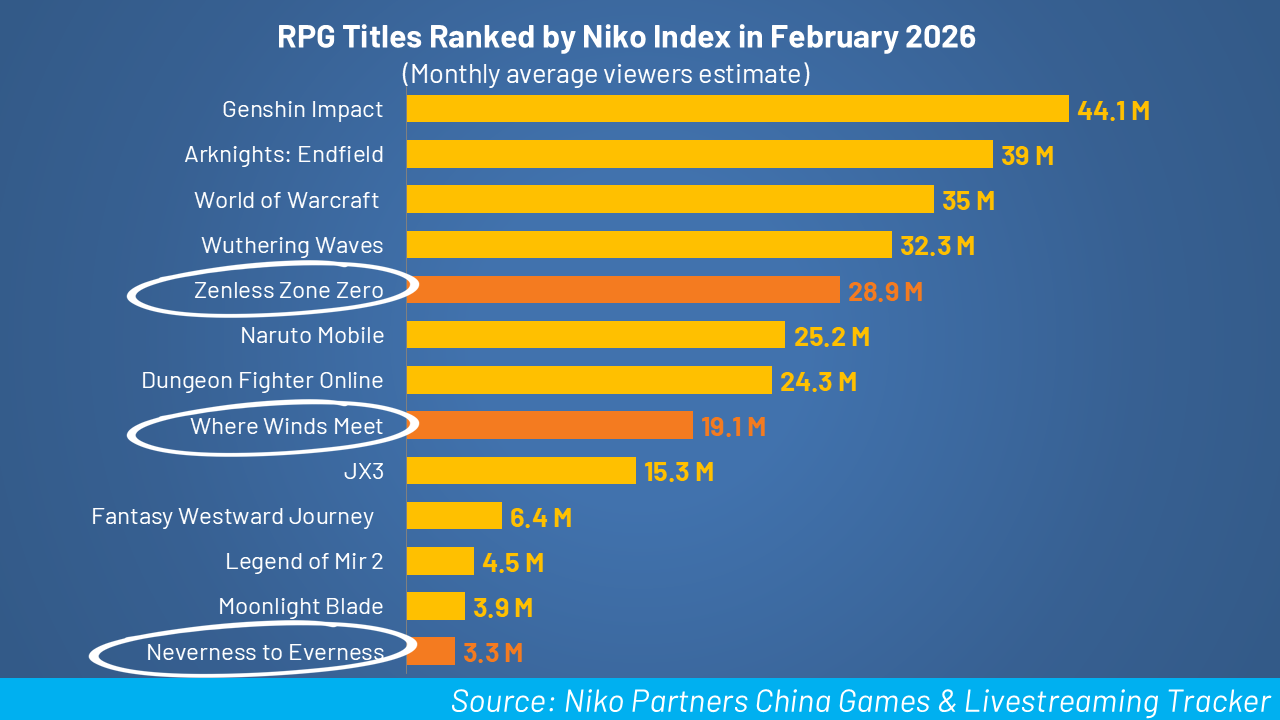
RPG titles continued to lead China’s livestreaming landscape in February 2026. Zenless Zone Zero peaked at 16.9 million views in a single day, while Where Winds Meet experienced a notable surge driven by new cosmetic releases and its Spring Festival Delicacies Collection. Meanwhile, Neverness to Everness built strong momentum ahead of its full cross-platform launch in April. Read the full highlights in our latest blog post.
Tencent reports CY2025 earnings
Tencent reported CY2025 revenue of RMB 751.8 billion ($107 billion), up 14% YoY, with net profit reaching RMB 229.8 billion ($32.7 billion), with a profit margin of 31% compared to 30% in the prior year. Tencent’s online games business reached RMB 241.6 billion ($34.4 billion), up 22% YoY, and we estimate that games revenue from social networks and services added an additional RMB 40.8 billion ($5.8 billion) to take total gaming revenue to RMB 282.5 billion ($40.2 billion). Domestic games revenue for the year was RMB 164.2 billion ($23.4 billion). up 17.6% YoY, while international games revenue reached RMB 77.4 billion ($11.0 billion), up 33.4% YoY.
Why this matters: This is the first time that international game revenues have surpassed $10 billion for Tencent, making it larger than most Western AAA video game companies by revenue. Growth was driven by record setting evergreen games both domestically and internationally, including Valorant, Clash Royale and Delta Force.
Niko Partners has recently explored the topic of evergreen games, which refers to a game built around exceptional replayability with no fixed endpoint, allowing players to stay engaged for months or years. Niko Partners has researched, written and published a new whitepaper called The Impact of Evergreen Games on the Global Market, where we describe the rise of evergreen games and what publishers and developers can learn to be ahead of the curve in today’s market. Download the whitepaper for free here.
Memory shortage to pressure Korean and Japanese game companies
Korean game industry reports indicated that a global memory semiconductor shortage is disrupting the gaming sector, delaying hardware releases, and increasing costs across the value chain. Sony may postpone the PlayStation 6 launch to 2028 or 2029, while Valve faces rising memory prices affecting gaming hardware such as Steam Machines. Major Korean game developers’ cost structure has been deteriorating due to competition between AI and gaming for data center resources resulting in server and cloud infrastructure becoming a primary cost burden in 2026.
Why this matters: Korean game companies that operate live service games, multiplayer servers, and large-scale backend systems are expected to face indirect impacts from memory constraints. The shortage extends beyond hardware supply disruptions, contributing to higher console and PC prices, reduced entry level device availability, and adjustments in pricing for games, subscriptions, and peripherals, thereby increasing overall cost pressures across the gaming market.
Link to original article (Korean) →
Indonesia upholds ruling requiring Google to allow alternative in‑app payment systems
The Indonesian Supreme Court has rejected Google’s cassation request, upholding KPPU’s ruling that the company violated competition laws by requiring developers to use Google Play Billing (GPB) for in‑app transactions. The decision affirms Google’s obligation to pay a IDR 202.5 billion ($12 million) fine and to stop requiring GPB as the exclusive in‑app payment method. KPPU’s investigation, launched in 2022, found Google controlled about 93% of Indonesia’s app distribution market and imposed 15–30 percent commissions under GPB.
Why this matters: Google must now implement User Choice Billing (UCB), enabling developers to use alternative payment systems. This ruling signals increasing regulatory pressure on platform‑controlled payment systems in Southeast Asia, potentially reducing fees and shifting monetization strategies for mobile game publishers. Developers should watch how Google implements UCB in Indonesia, as similar demands may emerge in other regional markets.
Link to original article (Indonesian) →
Apple reduces in-app purchase commission fee for China app store
Apple has reduced its App Store commission fees in mainland China, lowering the standard rate on in-app purchases from 30% to 25%, while cutting fees for small business and mini app developers from 15% to 12%. This is welcome news for game developers, including mini-game developers, which refers to instant games inside larger platforms like WeChat. The move follows increasing regulatory scrutiny and pressure in China, where platform economics and revenue-sharing models have become a focal point for policymakers.
Why this matters: The reduction represents a meaningful margin improvement for developers where the 30% Apple Tax has been the only option available for more than a decade. However, we note that third party Android app store fees can still go as high as 50% in some cases, and there has been no announced reduction from other stores at this point. That being said, the rise of direct distribution, mini games, web stores, and out of app monetization methods have long been utilized by developers to bypass app store commission fees.
Link to original article (Chinese) →
Savvy Games Group to acquire Mobile Legends: Bang Bang developer, Moonton in $6 billion deal
ByteDance has announced that they’ve agreed to sell their gaming unit, and makers of the immensely popular Mobile Legends: Bang Bang, Moonton, to Savvy Games Group for $6 billion. The valuation is a 50% increase from the $4 billion Bytedance spent to purchase Moonton back in 2021. This is a mutually beneficial deal for both parties, as Bytedance has been looking to divest some of its video game related assets over the past few years, while Savvy has been looking to grow its studio portfolio, strengthening Saudi Arabia’s position in the games industry.
Why this matters: Mobile Legends: Bang Bang remains one of the top MOBA games on smartphones today and is also a featured title at the Esports World Cup. However, we do note that Savvy CEO Brian Ward had previously said the company was looking to enter the PC & Console market, which makes the $6 billion acquisition of a mobile studio come as somewhat of a surprise. Savvy had $13.3 billion set aside for M&A since September 2022. Between Scopely’s acquisition in 2023 for $4.9 billion, and now this, $2.4 billion remain for future investments.
Link to original article (English) →
Universal Beijing Resort recreates Genshin Impact‘s Mondstadt
Universal Beijing Resort, operated by Comcast NBCUniversal, has launched its “Universal Infinite Spring” event (running through May 31, 2026), featuring a lineup of prominent Chinese IPs as part of its ongoing localization strategy. Key highlights include the debut of an immersive interactive restaurant, “Chang’an Banquet,” based on the animated film Chang’an, alongside experiential installations inspired by Genshin Impact, including a real-world recreation of Mondstadt. Universal’s strategy highlights how Western entertainment companies are adapting to China’s IP ecosystem.
Why this matters: The initiative reflects a deliberate shift toward integrating locally resonant IP into global theme park ecosystems, with the goal of increasing domestic visitor engagement and repeat visitation. In addition to Genshin Impact, the resort has previously incorporated elements from Honor of Kings, developed by Tencent, signaling a broader partnership approach with leading Chinese content creators. Titles like Genshin Impact are increasingly extending beyond digital platforms into location-based entertainment.
Link to original article (English) →
There’s nothing artificial about our consumer insights and business intelligence.
Chinese voice acting industry pushes back on AI voice usage
China’s voice acting ecosystem is increasingly pushing back against generative AI, as studios and talent move to define legal and commercial boundaries around voice data usage. Leading dubbing agency Qixiang Tianwai, which has contributed to major titles such as Genshin Impact, Honkai Impact 3rd, and Honor of Kings, has issued a formal statement opposing unauthorized use of voice data for AI training, warning that such practices constitute infringement and will be pursued legally.
Why this matters: The dispute reflects a structural tension as AI adoption accelerates across content production. Voice acting, historically a human-centric asset tied to identity and performance, is now vulnerable to low-cost replication and mass distribution via AI models. From an industry perspective, this development signals the early formation of a rights framework for AI-generated content, where stakeholders are proactively establishing boundaries ahead of formal regulation.
Link to original article (Chinese) →
China elevates video games in 15th five-year plan
China’s newly released 15th Five-Year Plan (2026-2030) formally elevates online games alongside web literature, film/TV, and animation as core components of the country’s cultural export strategy. The plan explicitly calls for “promoting high-quality online games to go overseas” while simultaneously emphasizing the need to “guide and regulate healthy development” of the sector, marking a notable evolution in policy positioning. The policy reflects an ongoing industry transition from scale-driven growth to quality-driven development, aligning with broader trends seen across China’s games sector over the past three years.
Why this matters: The language used is different from the 14th Five-Year Plan where games were only briefly referenced within broader digital culture exports. The new framework increases both the frequency and specificity of mentions, embedding games within two key strategic pillars: international export capacity and modern cultural industry system development. This shift signals a more structured approach to leveraging games as soft power tools and export-oriented digital products, while reinforcing regulatory oversight.
Link to original article (Chinese) →
Capcom says it will not implement Generative AI assets into its games
Capcom has clarified that it does not plan to use AI-generated assets directly in its game content, while continuing to test generative AI internally to improve development efficiency. According to comments from the company’s February shareholder meeting, Capcom said it “will not be implementing any assets into [its] video game content,” but is actively evaluating AI applications across graphics, sound, and programming workflows. The company’s stance follows earlier comments from Capcom technical director Kazuki Abe in 2025 that the publisher was experimenting with generative AI during the idea creation process.
Why this matters: This positions Capcom in a middle ground among large video game publishers, highlighting the use of generative AI as a production tool, but not a substitute for creative output, following backlash from users who oppose the use of the technology due to both low quality output and ethical issues. Niko Partners continues to see backlash to generative AI usage, more so in the West than the East, but notes that Asia based game developers are continuing to incorporate the technology and tools into game development processes while being wary of consumer sentiment.
Link to original article (English) →
Events
India Gaming Show
April 17-19, 2026
Chennai, India
Attendee: Narinder Kapur
Vietnam GameVerse 2026
May 8-9, 2026
Ho Chi Minh City, Vietnam
Attendees: Linh Diep, Hung Tang
GamesBeat Summit
May 18-19, 2026
Los Angeles, USA
Speaker: Lisa Hanson